
If you’ve spent any time in agent-building communities lately, you’ve probably noticed the same debate playing out over and over: Hermes Agent or OpenClaw? Both are open-source, both connect large language models to real tools and messaging apps, and both have attracted enormous developer attention in a very short window. But they were built around fundamentally different bets about what an AI agent should be.
We’ve dug into the architecture docs, the release histories, and the security disclosures for both projects to put together a clear, practical answer. By the end of this guide, you’ll know exactly which framework fits your use case – and where the differences between Hermes Agent and OpenClaw actually matter versus where they’re just marketing noise.
What Is OpenClaw, Exactly?
OpenClaw is a self-hosted, open-source runtime that connects large language models to the tools and systems people already use – files, calendars, messaging apps, code editors, and browsers. Rather than just answering questions, it’s built to take actions on a schedule and retain context between sessions.
The project has had an unusually dramatic origin story. It launched in November 2025 under the name Clawdbot, was renamed Moltbot in January 2026 after a trademark dispute, and rebranded again to OpenClaw on January 29, 2026. Despite the name changes, growth never slowed – it became one of the fastest-growing open-source repositories in GitHub history within months.
Architecturally, OpenClaw is organized around a Channel System, a central Gateway, a Plug-ins and Skills System, an Agent Runtime, a Memory and Knowledge System, an LLM provider layer, and a local execution environment. A single Gateway process multiplexes WebSocket and HTTP traffic, managing sessions, tool dispatch, and channel routing in one place. If you want the full technical breakdown, our OpenClaw architecture guide goes deeper into how the Gateway and Agent Runtime fit together.
What Is Hermes Agent? The Self-Improving Challenger
Hermes Agent is an open-source AI agent framework that creates skills from experience, improves them during use, and builds a model of the user across sessions. It was developed by Nous Research, the lab known for the Hermes, Nomos, and Psyche fine-tuned model families, and launched on February 25, 2026.
The core idea is what really separates the two frameworks. Hermes adds a “Reflective Phase” after every completed task – it analyzes its own performance, extracts reusable patterns, and writes a skill file documenting how it solved the problem. The next time a similar task comes up, the agent pulls from its own skill library instead of reasoning from scratch.
This is conceptually similar to the distinction between model-based and model-free approaches in reinforcement learning, where one strategy builds an internal model to plan ahead and the other reacts directly from experience. If that comparison interests you, our breakdown of model-based vs. model-free learning differences covers the underlying logic in more detail – Hermes’ learning loop borrows from that same family of ideas.
Architecture Differences Between Hermes Agent and OpenClaw
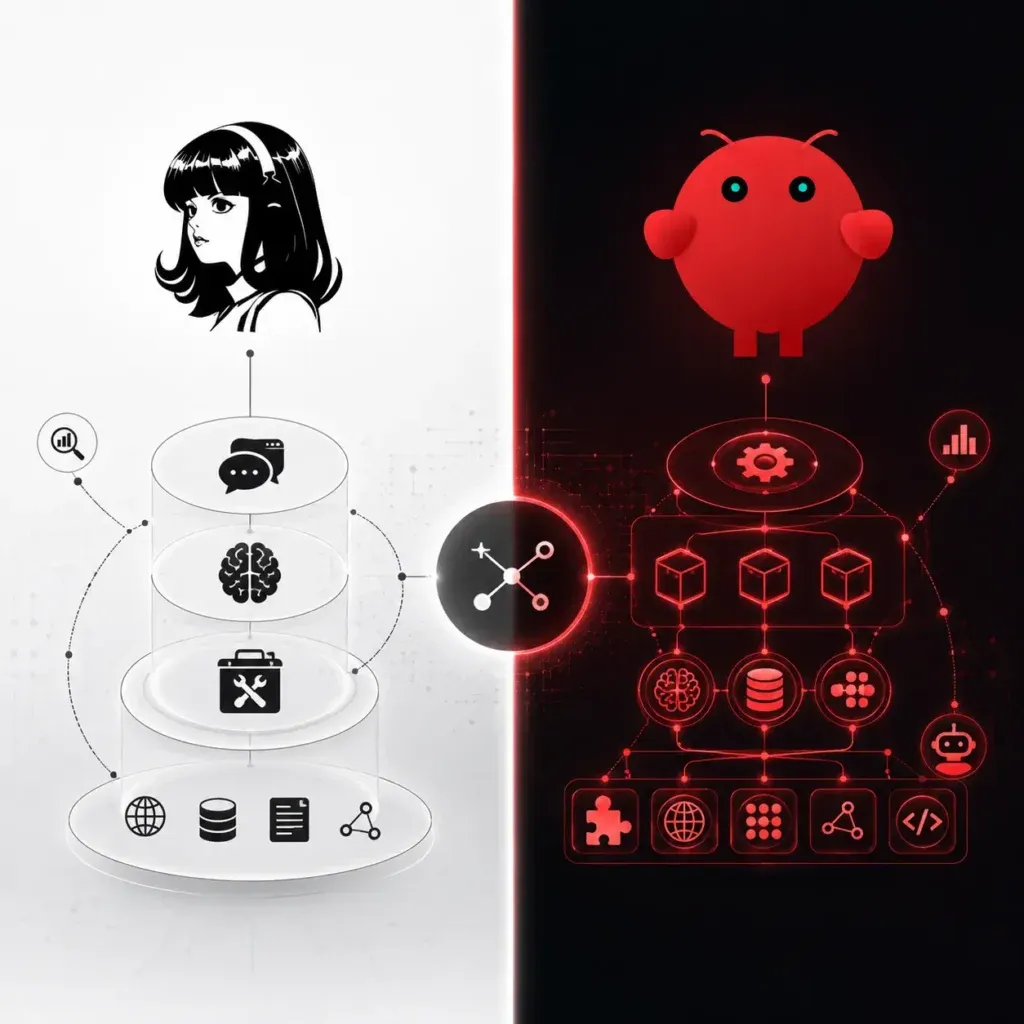
This is where the “Hermes Agent vs. OpenClaw” comparison gets genuinely interesting, because the two tools aren’t really solving the same problem.
OpenClaw functions as a standalone application rather than a code-first library – you clone a repository, configure environment variables, and run a process, which is a different category from frameworks developers import directly into their own code. It ships as a higher-level agent runtime with built-in tool integrations – web search, file operations, code execution, and browser automation included by default – and uses a plan-execute-reflect loop to break down and review its own work.
Hermes takes the opposite approach to flexibility. Setting up a full deployment means running or connecting to a compatible LLM endpoint and configuring your own vector database for long-term memory, using something like Chroma or Qdrant. That’s more setup work, but it hands you direct control over the retrieval logic – useful if your workflow has unusual memory requirements.
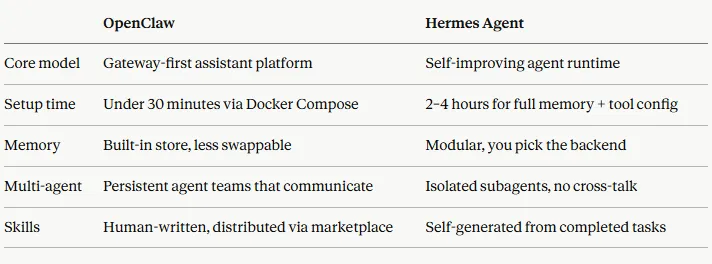
On multi-agent coordination, the two diverge sharply. OpenClaw supports persistent agent teams that can communicate, hold state, and work together across sessions, which makes it the stronger choice for genuine multi-agent setups. Hermes instead uses a parent-subagent model, where the main agent spins up isolated subagents for parallel execution, but those subagents don’t talk to each other.
Memory, Skills, and the Agentskills.io Standard
Both frameworks treat memory as central, but they get there differently. OpenClaw’s memory lives as plain Markdown inside the assistant workspace, with files like MEMORY.md acting as the source of truth, while Hermes uses what it calls Honcho dialectic user modelling to build an evolving profile of how someone works, plus FTS5 session search with LLM summarization for recalling past conversations.
Skill creation is the sharpest contrast. OpenClaw’s skills are human-written files distributed through ClawHub – you write them, review them, and install them. Hermes’ skills are written by the agent itself, based on its own experience, following the agentskills.io open standard – the same format used by coding assistants like Claude Code and Cursor. If you’re curious how that kind of skill-sharing standard plays out in a developer tool, our piece on the Cursor Canvas feature is a useful companion read.
Security: Where the Real Risk Lives
Security history is one area where the differences between Hermes Agent and OpenClaw aren’t subtle. OpenClaw experienced nine CVEs in four days in March 2026, including one scoring CVSS 9.9, and a supply-chain audit of ClawHub found roughly a 12% malicious-skill rate in an initial sample. Researchers also identified more than 135,000 publicly exposed OpenClaw instances across 82 countries.
Hermes has a cleaner record so far, but context matters. As of April 2026, Hermes had zero reported agent-specific CVEs, and because its skills are self-generated rather than downloaded from a community marketplace, it avoids that particular supply-chain attack vector entirely. That said, a smaller window of public exposure says nothing about whether vulnerabilities exist – only about whether they’ve been found yet. OpenClaw has since shipped meaningful hardening, including Docker sandbox improvements and safer plugin installs in its 2026.6.x patch series, so this gap is narrowing.
Setup, Cost, and Ecosystem Maturity
Both projects are free and open source, so your real cost is whatever LLM provider you connect to – that part is identical either way. OpenClaw runs on Node.js under an MIT license and is now stewarded by a non-profit foundation, with a thriving ClawHub marketplace and well over 100 built-in AgentSkills. Hermes Agent is built in Python, also under an MIT license, and shipped a native desktop app for macOS, Linux, and Windows in its June 2026 “Surface Release”.
Practically speaking, OpenClaw gets most people running real tasks the same day, since Docker Compose has it operational in under thirty minutes with web search and file tools working immediately. Hermes asks for more patience upfront in exchange for a system that compounds in capability the longer you run it.
Hermes Agent vs. OpenClaw: Which Should You Actually Pick?
There isn’t a universal winner here, and that’s not a cop-out – it’s the honest takeaway after comparing both systems closely. OpenClaw makes sense when the problem is orchestration: coordinating multiple agents, routing across many channels, and leaning on a mature plugin ecosystem. Hermes makes more sense when the problem is automation that needs to get measurably better over time – recurring reports, content pipelines, and research loops that benefit from accumulated muscle memory.
A growing number of experienced users have stopped treating it as either/or entirely, running OpenClaw as the orchestration layer and Hermes as a focused execution specialist for repeatable tasks. If you’re weighing this decision against other agent frameworks too, our broader AI agent workflow automation comparison walks through how these two stack up against alternatives like LangChain and CrewAI.
Frequently Asked Questions
What is the main difference between Hermes Agent and OpenClaw?
OpenClaw is a gateway-first assistant platform built for multi-channel orchestration and persistent agent teams. Hermes Agent is a self-improving runtime that writes its own skills from experience and gets better at recurring tasks over time.
Is OpenClaw or Hermes Agent more secure?
OpenClaw has documented CVEs and a known supply-chain issue through its ClawHub marketplace, while Hermes had zero reported agent-specific CVEs as of April 2026. That gap partly reflects Hermes’ shorter time in the wild, not a proven security advantage, and OpenClaw has since patched many of the issues. Medium
Can I use OpenClaw and Hermes Agent together?
Yes. A common pattern among experienced users is running OpenClaw as the orchestrator for planning and routing, while Hermes handles repeatable execution tasks where its learning loop adds the most value.
Which one is easier to set up?
OpenClaw is faster to deploy, typically under thirty minutes via Docker Compose, compared to roughly two to four hours for a full Hermes Agent setup with memory and tools configured. MindStudio
Are both frameworks really free?
Both are open source under permissive licenses (MIT for both, per current releases), so there’s no software fee. Your only ongoing cost is the LLM provider you connect — OpenAI, Anthropic, a local model, or whichever you choose.
The differences between Hermes Agent and OpenClaw boil down to a single architectural question: do you want breadth and orchestration, or do you want an agent that compounds in skill the longer it runs? Neither answer is wrong, but picking based on your actual workflow — not just GitHub star counts — will save you a rebuild down the line.
If you’d rather have an experienced team evaluate your specific use case and set up the right agent stack for you, our guide on finding the right AI development company is a solid next step.
