If you have been paying attention to the AI developer community in early 2026, you have probably seen one name come up repeatedly: OpenClaw. Originally published in November 2025 under the name Clawdbot by Austrian developer Peter Steinberger, it was renamed to OpenClaw in January 2026 and has since become one of the fastest-growing open-source projects in history, surpassing 250,000 GitHub stars in roughly 60 days.
But viral popularity alone does not tell you whether a framework is worth building on. In this guide, we go deeper — past the hype — to give you a practical understanding of OpenClaw’s architecture, how it scales, how it compares to alternatives like LangChain, CrewAI, and AutoGPT, and what you need to know before using it in a production AI agent system.
Whether you are a developer exploring autonomous AI agents for the first time or a technical architect evaluating OpenClaw for enterprise deployment, this guide covers everything you need.
What Is OpenClaw and Why Does It Matter?
Source: https://shorturl.at/4xiTL
OpenClaw is an open-source framework for building autonomous AI agents that run 24/7, remember context across sessions, and take actions on external services. It is self-hosted, model-agnostic (works with Claude, GPT-4, Ollama, and others), and stores all data locally in Markdown files for privacy.
The key difference between OpenClaw and a typical chatbot like ChatGPT is execution. When you ask ChatGPT to book a flight, it explains the steps. When you give the same instruction to OpenClaw, it attempts to actually carry it out — browsing the web, filling in forms, sending confirmations through your messaging apps. It is fully open-source (MIT), local-first, and autonomously scheduled via a heartbeat daemon that acts without prompting.
This positions OpenClaw not as a chatbot wrapper, but as a runtime for autonomous AI agents — and that distinction matters enormously when you are thinking about scalability.
The Five-Component Architecture of OpenClaw
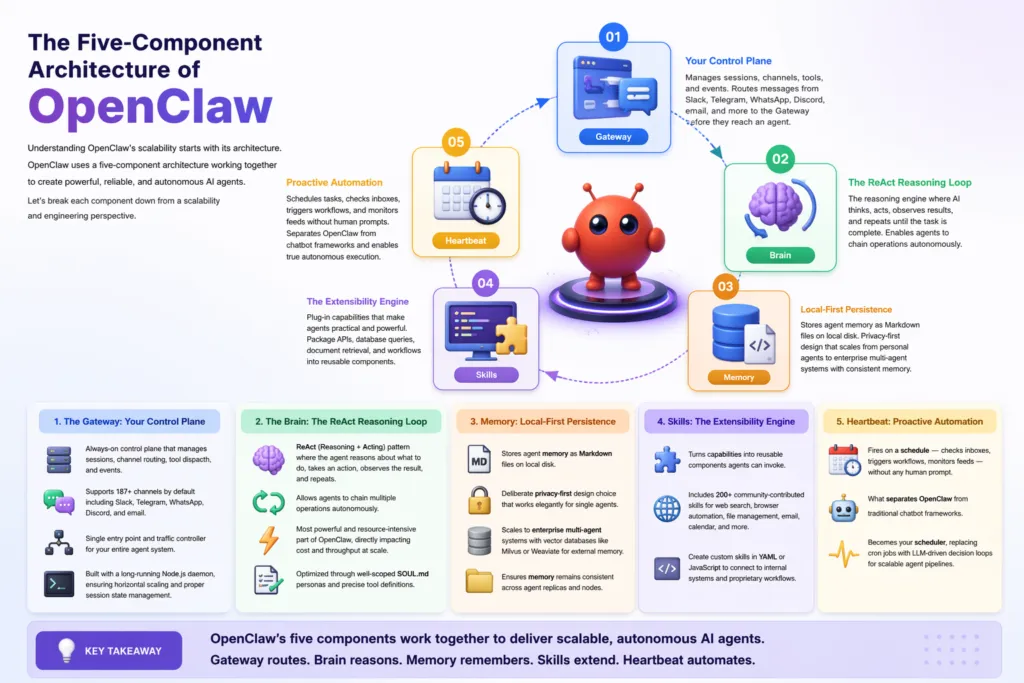
Understanding OpenClaw’s scalability starts with its architecture. OpenClaw uses a five-component architecture: Gateway (routes messages from channels like Slack and WhatsApp), Brain (orchestrates LLM calls using the ReAct reasoning loop), Memory (stores persistent context in Markdown files), Skills (plug-in capabilities for actions), and Heartbeat (schedules tasks and monitors inboxes).
Let’s break each component down from a scalability and engineering perspective.
The Gateway: Your Control Plane
The Gateway is the always-on control plane that manages sessions, channel routing, tool dispatch, and events. It binds to port 18789 by default and serves both a Control UI and a WebChat interface. Think of it as the single entry point and traffic controller for your entire agent system. Every message from every channel — Slack, Telegram, WhatsApp, Discord, email — passes through the Gateway before reaching an agent.
For scalable deployments, the Gateway is your first bottleneck to understand. It is a long-running Node.js daemon, which means horizontal scaling requires containerizing it carefully and ensuring proper session state management.
The Brain: The ReAct Reasoning Loop
The Brain is where reasoning happens. ReAct (Reasoning + Acting) is a pattern where an AI agent reasons about what to do, takes an action (calls a tool), observes the result, and repeats until the task is complete. This allows agents to chain multiple operations autonomously.
For scalable systems, this loop is both the most powerful and most expensive part of OpenClaw. Each cycle invokes your LLM backend. Optimizing token efficiency in the Brain — through well-scoped SOUL.md personas and precise tool definitions — directly impacts both cost and throughput at scale.
Memory: Local-First Persistence
OpenClaw stores agent memory as Markdown files on local disk. This is a deliberate privacy-first design choice. For single-agent personal deployments, it works elegantly. For enterprise-scale multi-agent systems, you will want to evaluate whether to persist memory externally — for example, to a vector database like Milvus or Weaviate — so that memory remains consistent across agent replicas and nodes.
Skills: The Extensibility Engine
OpenClaw skills are designed to make working with OpenClaw’s AI agents more practical, modular, and powerful. Instead of building every capability from scratch, Skills let you package specific functionality — like calling an API, querying a database, retrieving documents, or executing a workflow — into reusable components that an agent can invoke when needed.
OpenClaw has ClawHub, a dedicated skill marketplace with 200+ community-contributed skills covering web search, browser automation, file management, email, calendar, and more. For production deployments, you can also author private skills in YAML or JavaScript that connect to your internal systems.
The Heartbeat: Proactive Automation
Unlike reactive systems that wait for user input, OpenClaw’s Heartbeat daemon fires on a schedule — checking inboxes, triggering workflows, monitoring feeds — without any human prompt. This is what separates OpenClaw from chatbot frameworks and makes it genuinely autonomous. For scalable agent pipelines, the Heartbeat becomes your scheduler, replacing cron jobs with LLM-driven decision loops.
How OpenClaw Handles Scalability: Architecture Patterns
Building a production-grade, scalable AI agent system with OpenClaw requires going beyond default configuration. Here are the architectural patterns that work at scale.
Stateless Orchestration with External State
The OpenClaw orchestrator is stateless; agent state is external. Use Kubernetes or a managed container service to scale orchestrator pods based on queue depth. This is the key insight for horizontal scalability: keep your agent logic stateless and push all state — memory, session data, conversation history — into external storage. This lets you spin up and down agent instances on demand without losing context.
Warm Pools for Low Latency
Container spin-up time for new agents can hurt latency-sensitive workflows. Implement a warm pool of pre-initialized, generic agent containers ready to receive a specific goal and context. This pattern is borrowed from serverless architecture and works particularly well for OpenClaw agents that serve real-time user requests through messaging channels.
Rate Limiting at the Tool Layer
Autonomous agents can inadvertently DDoS your internal APIs. Implement a global rate limiter at the tool gateway — for example, using Redis — that respects overall system quotas, not just per-user limits. This is especially important when scaling to multiple concurrent agents that all have access to the same tool set.
Multi-Agent Coordination with AGENTS.md
For workflows that require multiple agents working in parallel or in sequence — a research agent, a writer agent, a publisher agent — OpenClaw supports multi-agent configurations through AGENTS.md files. Each agent gets a defined persona, tool set, and communication channel. For complex orchestration logic, many teams layer OpenClaw with a message queue to coordinate handoffs between agents.
OpenClaw vs. The Competition: Where Does It Actually Win?
To evaluate OpenClaw for scalable AI agent systems, you need an honest comparison against the main alternatives.
OpenClaw vs. LangChain
Source: https://shorturl.at/o15tz
LangChain is the most flexible AI agent framework for developers who need fine-grained control. It gives you deep programmatic control over every step of your agent’s logic, which makes it ideal for teams with strong Python expertise building bespoke pipelines. The tradeoff is complexity and setup overhead. OpenClaw wins on speed-to-deployment and operational simplicity, especially for teams that want agents running immediately without writing custom orchestration code.
OpenClaw vs. CrewAI
Source: https://shorturl.at/TcNN2
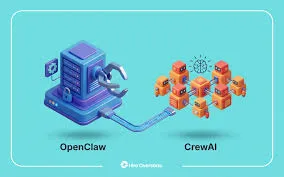
The core difference between OpenClaw and CrewAI is this: CrewAI is a Python developer framework for building multi-agent pipelines in code. OpenClaw is an end-user AI agent platform you run like an employee — no code required. CrewAI’s multi-agent orchestration is more mature for complex role-based workflows. OpenClaw supports multi-agent setups via AGENTS.md, but CrewAI’s multi-agent orchestration is more mature. For complex workflows where agents hand tasks to each other in defined sequences, CrewAI has the cleaner implementation.
OpenClaw vs. AutoGPT
Source: https://shorturl.at/LDoHn
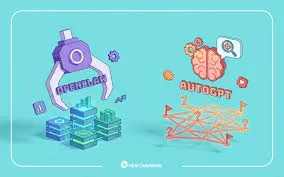
OpenClaw vs. AutoGPT: Both are end-user agent tools, but OpenClaw has a significantly more mature skill ecosystem and better messaging integrations as of 2026. AutoGPT pioneered the autonomous agent concept and has the longest community history, but its development pace has slowed compared to the rapid iteration happening in the OpenClaw ecosystem.
OpenClaw is the strongest choice for teams that want a working autonomous agent with messaging integrations, a rich skill ecosystem, and enterprise-grade deployment flexibility without requiring deep Python expertise. For purely code-driven multi-agent orchestration, CrewAI or LangGraph may offer more programmatic control.
Enterprise Deployment: What You Need to Know
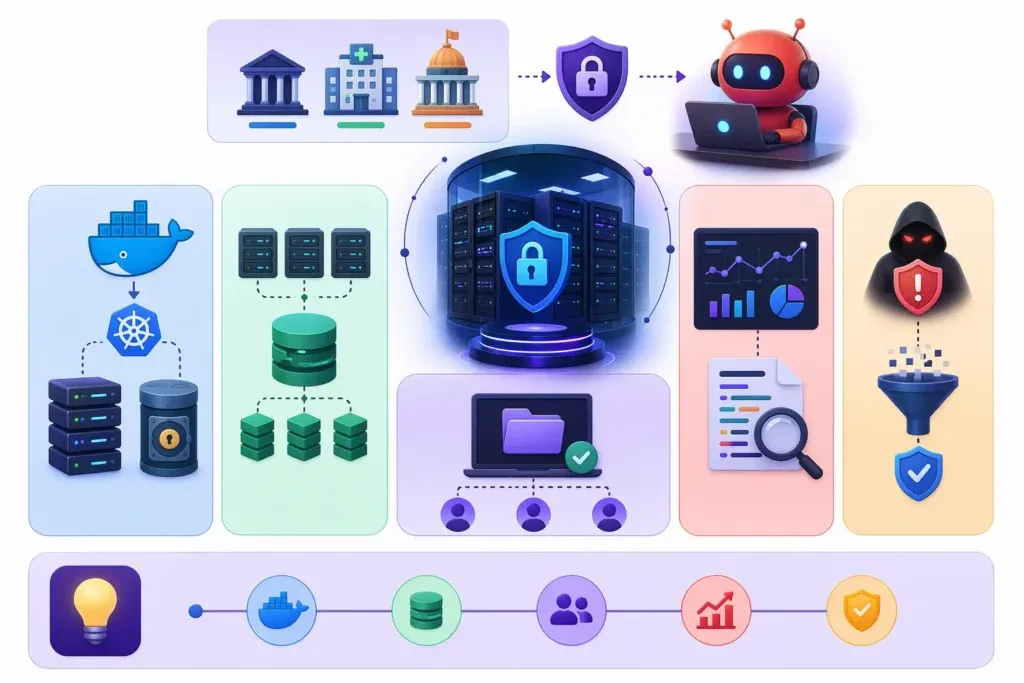
For organizations in regulated industries — financial services, healthcare, legal, government — the requirement that sensitive data not pass through third-party hosted systems is often non-negotiable. OpenClaw makes that possible while still using a leading LLM as the underlying model.
Here is what a production-ready OpenClaw enterprise deployment looks like:
Containerize the Gateway. Run the OpenClaw Gateway as a Docker container managed by Kubernetes. Use health checks and restart policies. Store secrets (API keys, channel tokens) in Vault or AWS Secrets Manager — never in openclaw.json directly.
Externalize Memory. For multi-instance deployments, replace the default Markdown file memory with a shared vector database. This ensures that all agent replicas read from and write to the same memory store, maintaining context consistency across the fleet.
Audit Your Skills. OpenClaw lets any developer publish a skill file on ClawHub, making it easy for developers to inject malicious instructions into these Markdown files and compromise systems. In enterprise environments, maintain a private, vetted skill registry and disable ClawHub access entirely. Review every skill’s permissions and source code before enabling it.
Implement Observability. OpenClaw’s agent loop is opaque by default. Add logging at the tool dispatch layer and instrument the Brain’s reasoning cycles so you can trace why an agent took a given action. Tools like Langfuse or custom OpenTelemetry pipelines work well here.
Handle Prompt Injection. OpenClaw is susceptible to prompt injection attacks, in which harmful instructions are embedded in the data with the intent of getting the LLM to interpret them as legitimate user instructions. Implement input sanitization at the Gateway layer and consider a secondary LLM guard that classifies incoming instructions before they reach the Brain.
Security Considerations: The Honest Picture
It would be irresponsible to publish an OpenClaw architecture guide without addressing security directly. OpenClaw’s design has drawn scrutiny from cybersecurity researchers and technology journalists due to the broad permissions it requires to function effectively. Because the software can access email accounts, calendars, messaging platforms, and other sensitive services, misconfigured or exposed instances present real security and privacy risks.
For teams building on OpenClaw at scale, the security checklist starts with: binding the Gateway to localhost only (never expose port 18789 publicly), using a reverse proxy with TLS termination for any web access, enabling allow-listing for external tool targets, rotating LLM API keys on a regular schedule, and running OpenClaw in an isolated network segment with egress filtering.
Security is not a reason to avoid OpenClaw — it is a reason to deploy it thoughtfully.
When Should You Choose OpenClaw for Scalable AI Agent Systems?
OpenClaw is a strong architectural choice when your requirements include self-hosted, data-residency-compliant agent deployment; proactive, schedule-driven automation without human prompts; messaging-native interfaces (agents that live inside Slack, WhatsApp, or Teams); rapid skill extensibility without needing to write Python orchestration code; and model-agnostic flexibility to swap between Claude, GPT-4, or a local model like Ollama.
It is a weaker choice when your primary need is complex programmatic multi-agent orchestration with role-based task delegation (consider CrewAI or LangGraph instead), or when your team’s strength is Python-heavy custom pipelines (consider LangChain).
Getting Started: The Architecture Checklist
Before you deploy OpenClaw for a scalable agent system, work through this checklist:
Define your agent’s scope in SOUL.md — clear personas reduce token waste and hallucination drift. Decide on your memory backend early — default Markdown files do not scale horizontally. Audit every skill before enabling it, especially from ClawHub. Containerize from day one, even for staging. Set up observability before going to production, not after. Implement a rate limiter at the tool layer if multiple agents will share APIs. Test prompt injection scenarios against your Gateway configuration.
OpenClaw represents a genuine shift in how autonomous AI agents are built and deployed. Unlike chatbot interfaces that wait for your input, OpenClaw operates proactively through a heartbeat daemon, scheduled tasks, and deep integrations with messaging platforms you already use. Its five-component architecture — Gateway, Brain, Memory, Skills, and Heartbeat — gives teams a clean mental model for reasoning about scalability, and the open-source MIT license means you control your entire stack.
The scalability challenges are real but solvable with the right patterns: stateless orchestration, externalized memory, containerized deployment, and a security-first approach to skill management. Teams that get this right will have one of the most powerful autonomous agent platforms available today running inside their own infrastructure.
