
Imagine you are dropped into a completely unfamiliar city. One person pulls out a map and studies the streets before taking a single step. Another simply starts walking, learning the city by getting lost and finding their way back. Both eventually figure out how to navigate — but they take very different paths to get there.
This is, at its core, the difference between model-based and model-free learning in artificial intelligence. It is one of the most fundamental divides in machine learning, and despite decades of research, it remains an open and genuinely important debate.
In this article, you will learn what each approach actually means in practice, where each one shines, what trade-offs you accept when choosing one over the other, and why a hybrid of the two may be the future of intelligent systems.
What Is Model-Free Learning?
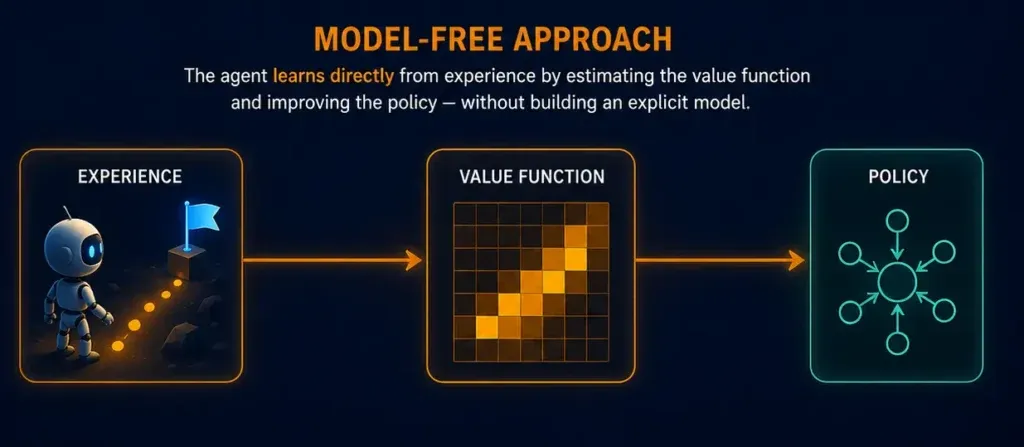
Model-free reinforcement learning refers to methods where an agent learns directly from interactions with the environment — without building an internal model of how the environment works. The agent develops policies or value functions based entirely on observed rewards and state transitions.
Think of it as learning by doing, repeatedly. The AI takes an action, sees what happens, and adjusts its behavior accordingly. Over many repetitions, it builds up a sense of what works and what does not — not because it understands the rules of the world, but because it has experienced enough of the outcomes.
There are two main categories within model-free RL: policy-based methods, which directly optimize the policy that maps states to actions (such as REINFORCE and Proximal Policy Optimization), and value-based methods, which learn the value of taking certain actions in certain states.
When Does Model-Free Learning Work Best?
Model-free methods have a proven track record in complex tasks. AlphaGo’s early training and Atari game-playing AI are both rooted in model-free deep reinforcement learning, making this approach a go-to for complex problems where building an accurate environment model is impractical.
However, it comes with real costs. These algorithms often need enormous amounts of experience to learn — sometimes millions of interactions. The agent cannot think ahead or simulate “what if” scenarios, and learning one task does not transfer well to another.
What Is Model-Based Learning?
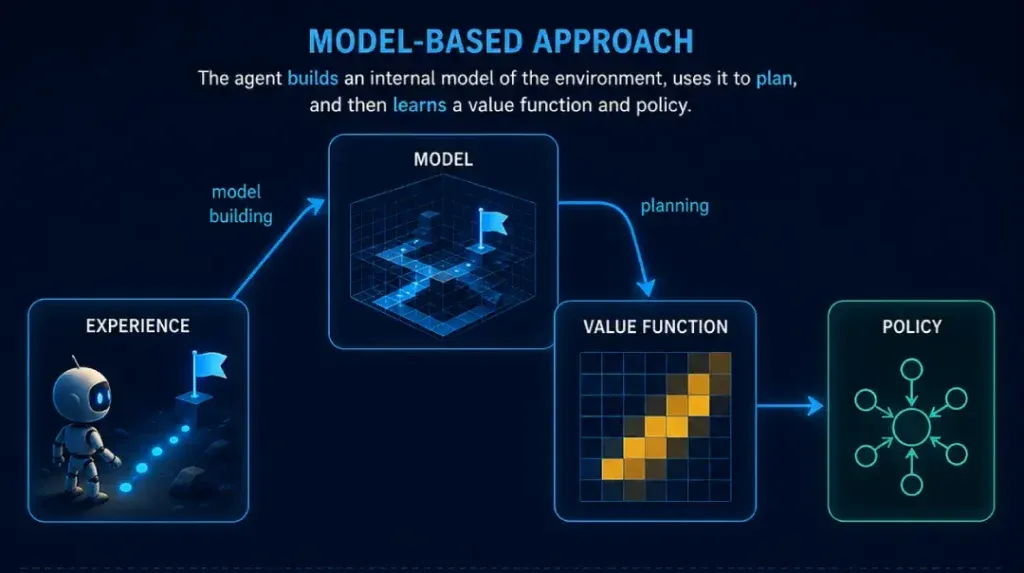
Model-based learning involves constructing an explicit internal model of the environment. Instead of learning purely from trial and error, the agent uses this model to plan ahead — essentially simulating future outcomes before committing to an action.
Going back to the city analogy: model-based learning is the person with the map. They can mentally trace several possible routes before even leaving the building. This ability to “imagine” outcomes changes the nature of how learning happens.
A clear example is Monte Carlo Tree Search, used in systems like AlphaGo to simulate future game states and evaluate moves. Model-based methods can achieve higher sample efficiency because the agent can “imagine” outcomes without always interacting with the real environment. However, their performance depends heavily on the accuracy of the model.
The Catch: Model Accuracy Is Not Guaranteed
This is where model-based approaches face their biggest limitation. If the model is flawed — for example, if a robot’s physics simulator mispredicts friction — the agent’s plans can fail badly in the real world.
Building and maintaining a model adds complexity and computational overhead. The model needs to be accurate enough to be useful, which can be challenging in environments with high complexity or uncertainty.
The Core Difference Between Model-Based vs Model-Free Learning
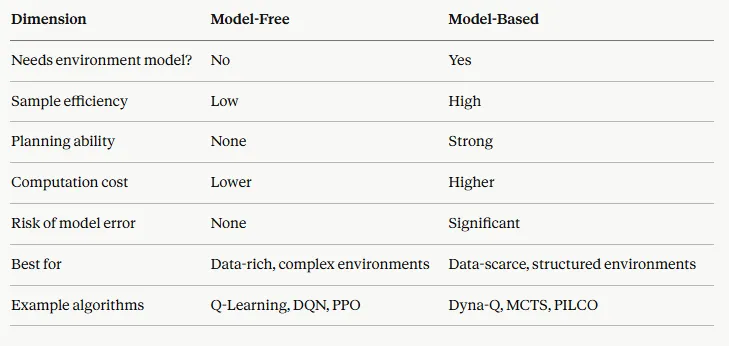
The simplest way to understand the core difference: if an agent can learn by making predictions about the consequences of its actions, it is model-based. If it can only learn through direct experience, it is model-free.
Here is a practical comparison:
Sample Efficiency: The Argument That Keeps the Debate Alive
If there is one technical concept at the heart of the model-based vs model-free learning debate, it is sample efficiency — and it matters enormously in real-world applications.
Model-based methods tend to be more sample efficient, as they make better use of the data gathered from the environment by learning a model and then exploiting it to improve the policy.
In practical terms, this means a model-based agent can learn a task after far fewer attempts than a model-free agent. For an AI operating in the real world — a robotic arm, an autonomous vehicle, a logistics optimization system — collecting millions of real-world training interactions is not always possible or safe.
Many real-world applications are going to require model-based approaches precisely because model-free methods are too sample-inefficient and show poor performance in early stages of training. This is particularly important in industrial settings where training interactions directly affect revenue.
If you are building AI for logistics or supply chain optimization, this efficiency gap is not a theoretical concern — it is a practical constraint that shapes what is even feasible.
Real-World Use Cases: Which Approach Fits Where?
Neither approach wins universally. The right choice depends heavily on the specific problem.
Where Model-Free Tends to Win
Model-free methods shine in environments that are either too complex to model accurately or where there is abundant data available. Video game AI, natural language tasks, and recommendation engines have all benefited from model-free deep learning techniques. The environment rules are either implicit or too high-dimensional to capture in a clean model, so the brute-force approach of learning from experience at scale works well.
Where Model-Based Tends to Win
Model-based approaches are preferred in physical systems where real interactions are expensive or dangerous. Robotics, healthcare treatment planning, and autonomous driving are domains where you genuinely cannot afford millions of trial-and-error episodes. The agent needs to get it mostly right early on, which requires planning ahead.
Real-world physical systems such as robots are typically costly and time-consuming to operate, making it highly desirable to learn using the lowest possible number of real-world trials.
This is also deeply relevant when you are thinking about how AI differs from traditional software — traditional software follows explicit rules, model-based RL builds its own rules, and model-free RL skips the rules entirely.
The Hybrid Future: Combining Both Approaches
The most interesting development in recent years is that researchers are no longer forcing a binary choice. Hybrid approaches that combine model-based efficiency with model-free robustness have produced some of the best results in the field.
Hybrid model-based and model-free algorithms can accelerate learning, achieving sample efficiency gains of 3 to 5 times on standard robotics benchmarks compared to pure model-free learning.
Interest has been growing in combining the advantages of both approaches, inspired partly by Dyna-Q — one of the earliest hybrid methods — which trains on both real and model-generated experiences.
The underlying logic is elegant: use a model-based approach to get a fast, reasonably good starting point, then let model-free fine-tuning correct for the model’s inaccuracies over time. Each approach patches the other’s weakness.
Behavioral and neural evidence from human cognition also supports a hybrid model — individuals naturally exhibit mixtures of both model-based and model-free behavior, suggesting the brain itself uses both strategies.
This convergence has real implications for how companies approach AI development. If you are exploring how to find the right AI development company, asking whether their RL implementations are model-based, model-free, or hybrid is a meaningful technical question that can tell you a lot about their approach to real-world deployments.
FAQ: Model-Based vs Model-Free Learning
Q: What is the simplest way to explain model-based vs model-free learning? Model-based learning builds a mental map of the environment first, then uses it to plan actions. Model-free learning skips the map entirely and learns what works through direct trial and error.
Q: Which is better — model-based or model-free? Neither is universally better. Model-based methods are more efficient when data is scarce or real-world interactions are costly. Model-free methods are often more robust and practical when the environment is too complex to model accurately or when abundant training data is available.
Q: Is Q-Learning model-based or model-free? Q-Learning is a model-free method. While it builds a Q-table that represents learned values, it does not predict future states or simulate outcomes — it learns purely from experience.
Q: Can model-based and model-free approaches be combined? Yes — and this hybrid direction is currently one of the most active areas of research. Systems that use model-based methods to initialize learning and model-free methods to refine it have shown significantly better performance than either approach used alone.
Q: Why does the model-based vs model-free debate still matter in 2025? Because AI is increasingly being deployed in environments where data collection is expensive, dangerous, or slow — healthcare, robotics, industrial systems. In those contexts, the choice of learning paradigm has direct consequences on cost, safety, and performance. The debate is not just academic; it shapes what real AI systems can and cannot do.
Conclusion: The Debate Is a Feature, Not a Bug
The ongoing tension between model-based and model-free learning reflects something genuinely hard about intelligence: do you build a model of the world, or just act and learn from outcomes?
Both paths lead somewhere useful. Model-free methods have produced some of the most impressive AI achievements in games and language. Model-based methods are quietly becoming essential in the real-world systems that cost money to run and risk harm if they fail. The hybrid approaches emerging from research labs suggest the future lies not in picking a winner, but in knowing when to use each and how to combine them intelligently.
For practitioners, the practical takeaway is this: match the learning paradigm to the constraints of your problem. If data is cheap and the environment is complex, model-free is your friend. If real-world interactions are limited and the environment has structure you can capture, model-based methods will save you time and resources. And if you are building something sophisticated, the hybrid path is worth exploring seriously.
Understanding this distinction is not just a technical nicety — it is foundational to building AI systems that actually work in the real world.
