The conversation around AI and traditional software has fundamentally changed in the past twelve months. This is no longer a debate about whether AI is ready for business — it is a debate about whether your business is ready for AI. Gartner’s latest research confirms that 40% of enterprise applications will have embedded task-specific AI agents by the end of 2026, up from less than 5% in 2025. Deloitte’s 2026 enterprise report finds that organisations still layering bolt-on AI over legacy systems are exposing themselves to structural competitive disadvantage. And across the SMB landscape, Business.com’s 2026 Small Business AI Outlook reports that 62% of small businesses have now adopted AI in both customer service and marketing, with more than half adopting it in operations, financial management, and product development.
The question has shifted. It is no longer “should my business use AI?” It is “which of my current systems is now costing me more to keep than to replace — and what does a smart transition actually look like?”
This guide gives you the 2026 answer: what traditional software still does well, where it is now actively holding businesses back, the eight specific signals that your organisation is ready to make the move, what the new economics of AI software look like, and how to navigate the transition without disruption.
What Changed Between 2025 and 2026: Why This Conversation Is Different Now
Understanding why the AI vs. traditional software decision is more urgent in 2026 than it was even twelve months ago requires understanding what has actually changed in the software landscape — not what is predicted or promised, but what is already deployed and measurable.
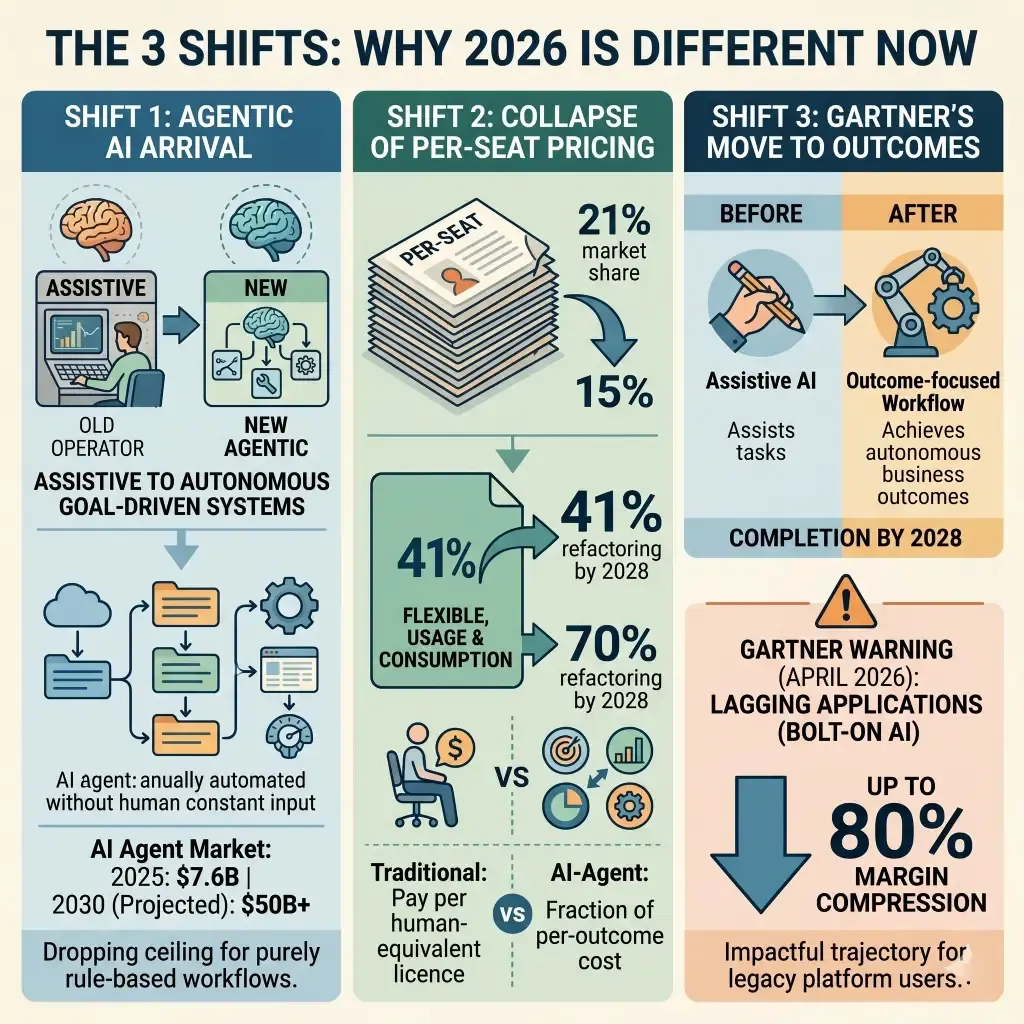
The first shift is the arrival of agentic AI at commercial scale. Earlier AI software was primarily assistive — it helped humans work faster on tasks they were still directing. Agentic AI is different in kind. These are autonomous, goal-driven systems that can plan multi-step processes, use tools and APIs, make decisions within defined parameters, and adapt their approach based on outcomes, all without constant human input at each step. According to industry forecasts, the AI agent market crossed $7.6 billion in 2025 and is projected to exceed $50 billion by 2030. Today, around 80% of enterprise applications are expected to embed agent capabilities by end of 2026. For businesses still running purely rule-based workflows, this represents a ceiling that is dropping in real time.
The second shift is the collapse of the traditional per-seat software pricing model. Forrester Research data shows that seat-based pricing dropped from 21% to 15% of SaaS market share in a single year, while hybrid and usage-based models surged to 41%. IDC’s FutureScape: Worldwide Agentic AI 2026 Predictions report states that by 2028, pure seat-based pricing will be obsolete, with 70% of software vendors refactoring their pricing around consumption, outcomes, or organisational capability. What this means practically is that the economics of software are being reset. A business paying per-seat for a CRM and a support platform may be paying for human-equivalent licences that an AI agent could replace at a fraction of the per-outcome cost.
The third shift is what Gartner has described as the move from “assistive AI” to “outcome-focused workflow” — a transition Gartner expects most enterprises to complete by 2028. Software that merely assists humans in performing tasks is being displaced by software that achieves defined business outcomes autonomously. Gartner’s April 2026 research warns that software companies layering bolt-on AI over legacy applications rather than redesigning for agentic execution will face margin compression of up to 80%. For businesses using those legacy platforms, that trajectory matters.
What Traditional Software Still Does Well in 2026
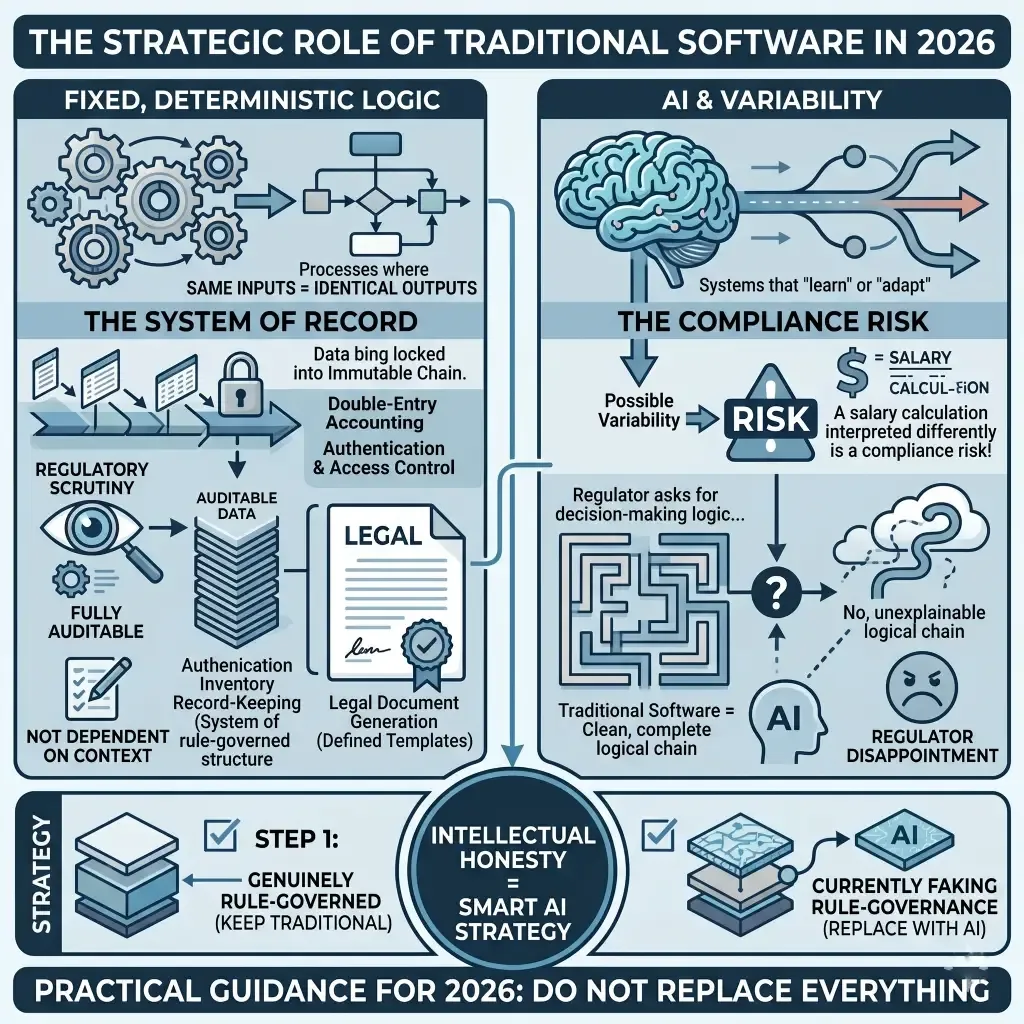
Being intellectually honest about where rule-based systems remain the right choice is not a concession — it is the foundation of a smart AI strategy. Replacing everything with AI because it is the current narrative is as much of a mistake as refusing to change anything.
Traditional software with fixed, deterministic logic remains the right choice for any process where the correct output must be identical given the same inputs, fully auditable under regulatory scrutiny, and not dependent on external context or learned patterns. Financial calculations, payroll processing, tax compliance reporting, double-entry accounting, authentication and access control, inventory record-keeping as a system of record, and legal document generation with defined templates all belong in this category.
In these domains, a system that “learns” or “adapts” introduces the possibility of variability where the business or its regulators require certainty. An AI model that occasionally interprets a salary calculation differently based on recent data patterns is not an improvement — it is a compliance risk. Traditional software also maintains a significant advantage in auditability. When a financial regulator asks for a complete logical chain explaining why a specific decision was made, rule-based systems can produce one cleanly and completely. Many AI models, particularly complex ones, cannot.
The practical guidance for 2026 is not “replace your accounting software with AI.” It is “identify which layer of your technology stack is genuinely rule-governed and which layer is currently faking rule-governance because you had no better option.”
Where Traditional Software Is Now Actively Costing You
This is the centre of the 2026 conversation. Legacy software and rigid rule-based tools are no longer merely limited in certain contexts — they are now creating measurable competitive drag in several specific areas.
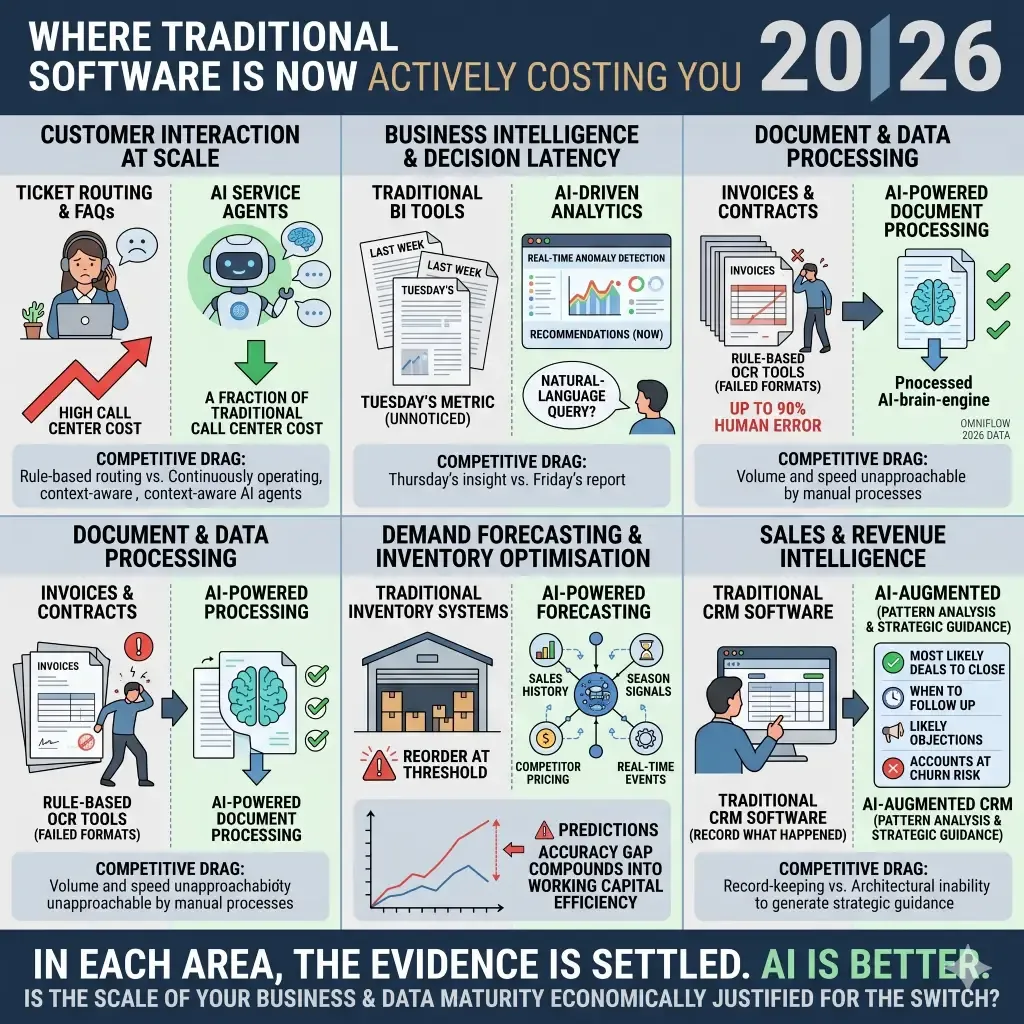
The first is customer interaction at scale. Traditional support software routes tickets and holds FAQs. In 2026, AI-powered customer service agents handle 60–80% of tier-1 support inquiries end-to-end without human intervention, understanding context, escalating intelligently, and operating continuously at a fraction of traditional call centre cost. Businesses still processing every support query through rule-based routing systems are operating with a structural cost and response-time disadvantage against competitors who are not.
The second is business intelligence and decision latency. Traditional BI tools tell you what happened — last week, last quarter, after someone built a report. A key metric can deteriorate on Tuesday and nobody on your team finds out until Friday’s report. AI-driven analytics watch for anomalies in real time, surface recommendations when there is still time to act, and can answer natural-language queries directly without requiring a data analyst to build the right dashboard first. In markets moving at 2026 speed, the difference between Thursday’s insight and Friday’s report is not trivial.
The third is document and data processing. Invoices, contracts, medical records, and operational reports contain information in formats that traditional rule-based parsing cannot handle reliably when format or language varies. AI-powered document processing reduces human error by up to 90% in data extraction workflows, according to Omniflow’s 2026 AI software development data — and operates at a volume and speed that manual processes and rule-based OCR tools cannot approach.
The fourth is demand forecasting and inventory optimisation. Traditional inventory systems reorder when stock falls below a threshold. AI-powered forecasting analyses sales history, seasonal signals, competitor pricing, external events, and real-time supply chain data simultaneously, producing predictions with an accuracy gap that compounds into significant differences in working capital efficiency over a financial year.
The fifth is sales and revenue intelligence. Traditional CRM software records what happened in a customer relationship. AI-augmented CRM analyses patterns across all customer interactions to predict which deals are most likely to close, when to follow up, what objections are likely to arise, and which accounts are at churn risk — giving sales teams strategic guidance that rule-based systems are architecturally incapable of generating.
In each of these areas, the question is no longer whether AI can do this better than traditional software — the evidence is settled. The question is whether the scale of your business and the maturity of your data make the switch economically justified right now.
The New Economics of AI Software in 2026
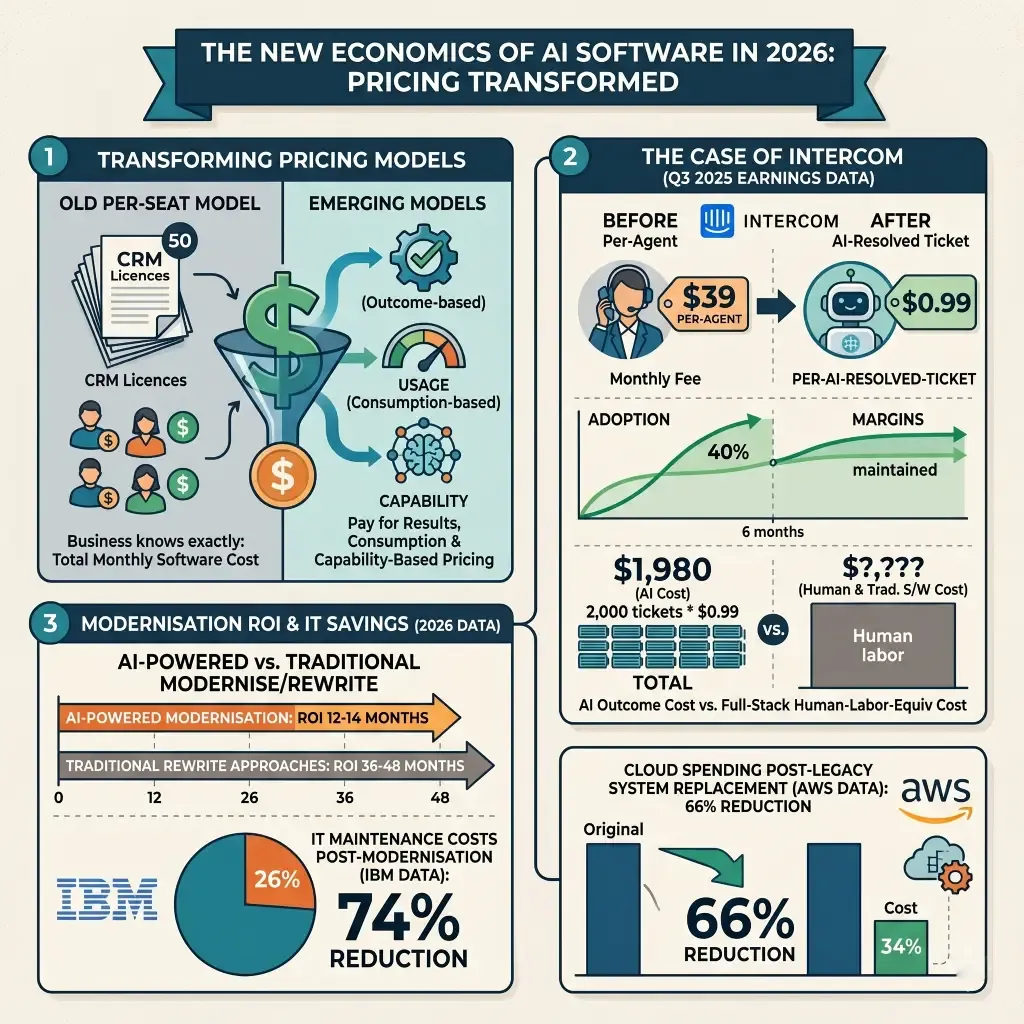
One of the most important 2026 developments for business decision-makers is the transformation of how AI software is priced — because it changes the financial case for switching in ways that are not obvious from headline licence comparisons.
Under the old per-seat model, a business paying for 50 CRM licences knew exactly what its software cost per month. Under the emerging outcome-based and usage-based models, the economics look fundamentally different. Intercom switched from a $39 per-agent monthly fee to a $0.99 per-AI-resolved-ticket pricing model, resulting in 40% higher adoption and maintained margins within six months according to their Q3 2025 earnings. If an AI agent resolves 2,000 support tickets per month at $0.99 each, the total cost is $1,980. The equivalent cost in human agent time and traditional software licencing is rarely that low.
The broader shift is what IDC describes as the move toward consumption, outcome, and capability-based pricing — where you pay for results rather than access. For businesses evaluating AI against traditional software on a cost basis, this means the comparison is no longer “AI licence cost vs. traditional software licence cost.” It is “AI outcome cost vs. the full-stack cost of achieving that outcome with traditional software plus the human labour required to operate it.”
Legacy software modernisation data published in early 2026 shows that AI-powered modernisation delivers positive ROI in 12–14 months on average, compared to 36–48 months for traditional rewrite approaches. IBM data cited in the same research shows a 74% reduction in IT maintenance costs post-modernisation, with AWS infrastructure cost data showing 66% reductions in cloud spending after legacy systems are replaced with cloud-native AI architectures.
8 Signals Your Business Is Ready to Make the Switch in 2026
These eight signals are drawn from the 2026 data on AI adoption patterns, SMB adoption research, and enterprise deployment experience. They are practical, not theoretical — each one is a condition your current technology stack is either meeting or not meeting right now.
- The first is that your team’s highest-skilled people are spending meaningful time on pattern-based, repetitive tasks. If experienced employees are categorising support tickets, extracting data from documents, researching prospects, or building the same reports on a weekly cycle, those tasks are candidates for AI handling, and the labour cost attached to them is the true cost of not switching.
- The second is that your competitive intelligence arrives too late to act on. If you are learning about market changes, competitor moves, or customer churn signals in weekly or monthly reports rather than in real time, your decision latency is a structural competitive disadvantage in 2026 — and it is a consequence of your BI and analytics architecture, not your team’s alertness.
- The third is that your customer experience is capped by manual processes. If every customer gets the same email sequence, the same response time, the same FAQ regardless of their history, intent, or urgency, you are delivering an average experience to every individual customer. In 2026, AI-personalised experiences are the expectation, not the premium. Businesses not meeting that expectation are experiencing churn they are attributing to other causes.
- The fourth is that you are managing 10 or more SaaS tools with no connecting intelligence layer. Business.com’s 2026 research found that SMBs running between 10 and 20 disconnected SaaS applications experience significant operational friction — data in one system is not visible in another, workflows require manual handoffs between tools, and no single view of customer or operational status exists. This is exactly the condition that an AI integration layer solves: a connected system where data moves automatically and decisions surface contextually across the stack.
- The fifth is that your forecasting is backward-looking. If your inventory, sales, financial, and resource planning is driven by historical averages rather than predictive models, you are managing a 2026 business with 2015-era decision infrastructure. The gap between historical reporting and predictive intelligence is now large enough to produce meaningful competitive disadvantage in fast-moving markets.
- The sixth is that your data volume has outgrown your team’s ability to use it. Many businesses have accumulated years of transactional, customer interaction, and operational data that sits in warehouses and is accessed only in quarterly reviews. If the data exists but the insight does not flow from it in time to influence decisions, that is not a data problem — it is an architecture problem that AI is specifically designed to resolve.
- The seventh is that your software vendor’s AI roadmap is about adding AI features to existing seats rather than redesigning for agentic execution. Gartner’s research is explicit that software companies layering bolt-on AI over legacy architecture — rather than rebuilding for autonomous, outcome-driven workflows — face margin compression and eventual displacement. If your current vendors are in this category, the question of when to switch is becoming a question of competitive positioning rather than technology preference.
- The eighth is that you have already run a small AI pilot that showed clear value but stalled at the point of scaling. This is the most common pattern in 2026 enterprise AI adoption: experiments work, but the organisation lacks the architecture and governance to expand them. According to McKinsey’s 2025/26 data, only 38% of organisations have successfully scaled AI beyond pilot projects. If you have the proof-of-concept evidence, the missing piece is a structured integration and scaling strategy — not more evidence.
The 2026 Approach: Orchestrated Hybrid, Not Full Replacement
The framing of “AI versus traditional software” is itself a 2024 mental model. In 2026, the leading enterprise technology firms — including Graphwise and Propel Software, cited in Intelligent CIO’s enterprise AI analysis — describe the winning architecture as hybrid orchestration: traditional software as the reliable, auditable backbone for rule-governed processes, with an AI orchestration layer above it that routes decisions to the right model, enforces compliance, contextualises data across systems, and executes agentic workflows where they create value.
This means a business does not need to choose between its ERP and an AI agent. It builds an intelligence layer that reads from the ERP, reasons about what needs to happen, takes defined actions across connected systems, and escalates to a human only when the situation falls outside the agent’s parameters. The traditional system remains the system of record. The AI layer is the decision and execution layer operating on top of it.
For businesses at the beginning of this transition, the practical path is to identify the highest-value use case — the one where the gap between current performance and what AI could achieve is largest and most measurable — and build the orchestration layer around that specific workflow first. Validate the result. Expand systematically.
Think To Share’s AI development and digital transformation services are built around this orchestrated hybrid model. Rather than recommending wholesale replacement of functioning systems, our team assesses which workflows within your current technology stack carry the highest return from AI integration and builds the connecting architecture to deliver measurable results at each phase. Across custom software development, web and mobile development, and AI integration projects, Think To Share has delivered for 300+ clients across 35 industries — with a 4.9/5 verified rating across Clutch, GoodFirms, and DesignRush.
In 2026, the AI versus traditional software decision is no longer about technology readiness — the technology is ready. It is about business readiness: whether your workflows, your data, and your governance structures can support a shift from rule-following software to outcome-achieving AI. The businesses gaining the most ground right now are not the ones that replaced everything. They are the ones that identified precisely where their traditional systems were creating the largest drag and built targeted AI integrations at those exact points, validated the ROI, and expanded systematically from there.
Traditional software is not going away. Financial systems, compliance infrastructure, and deterministic record-keeping will run on rule-based logic for years to come. But the decision and execution layer that sits above those systems — customer experience, demand intelligence, sales strategy, operational forecasting — is being rebuilt around AI agents and autonomous workflows faster than most businesses are tracking.
The cost of waiting is no longer theoretical. It is the gap between your current decision latency and your competitor’s, measured in market share.
If you want a clear-eyed assessment of where AI integration creates the strongest case within your specific technology stack — and a team with 300+ client engagements across 35 industries to build and deliver it — Think To Share is ready to start that conversation.
