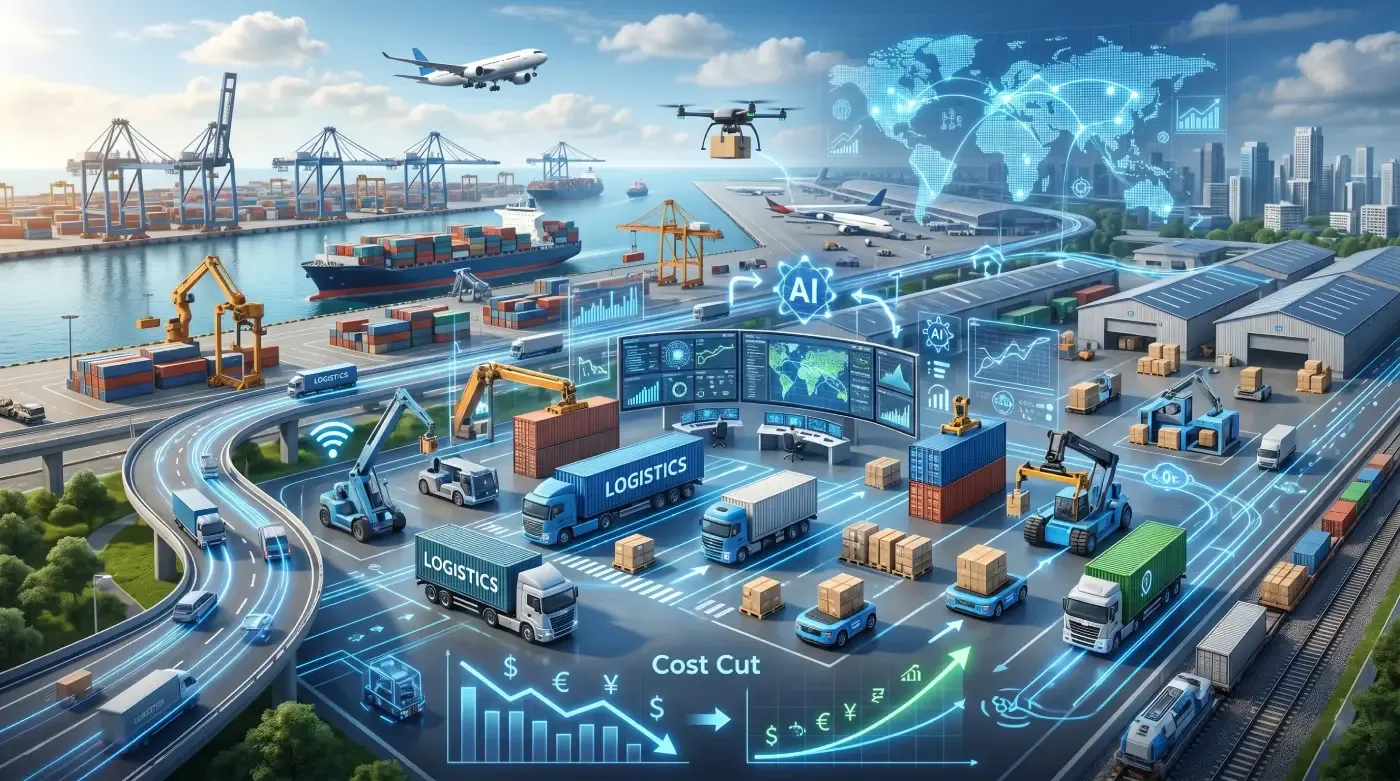
Logistics has always been a margin-thin, execution-heavy business. The difference between a profitable shipment and a costly one can come down to an inefficient route, a vehicle breakdown at the wrong moment, an inaccurate demand forecast, or a customs document that takes four hours to process manually. For decades, logistics companies accepted these inefficiencies as the cost of doing business. In 2026, the ones growing fastest are treating them as solvable problems — and they are solving them with AI.
The average supply chain is only 43% digitised, and traditional freight management faces a crucial turning point. That gap is exactly where AI is moving in. McKinsey reports that businesses which quickly adopted AI-driven supply chain management experienced a 15% reduction in logistics costs, a 35% decrease in inventory levels, and a 65% increase in service levels. These are not projections. They are documented outcomes from companies that have already deployed AI at scale — and the window for competitive advantage from early adoption is narrowing.
This guide breaks down exactly how logistics and cargo companies are cutting costs with AI in 2026, which tools are producing results, what the real ROI looks like, and how companies of every size can begin implementing these capabilities.
The Scale of the Opportunity
Before examining specific use cases, the overall financial picture deserves context. AI in logistics delivers measurable results: AI-enabled supply chains experience a 35% inventory reduction and 65% increase in service levels, better routing and predictive insights drop logistics costs by 15%, and warehouses gain up to 15% more capacity without new buildings.
Executives anticipate meaningful cost reductions through fuel and mileage optimisation, greater resilience in the face of disruption, and improvements in data quality driven by continuous feedback loops. The same research notes that integration with legacy systems remains the most cited barrier, followed by inconsistent data quality — which means the companies that invest in clean data foundations alongside AI deployment are gaining a structural advantage over those that do not.
A 2026 global survey found that enterprises with mature AI operations achieved 25 to 30% higher process efficiency in transportation and warehousing compared with those relying on legacy tools. A Georgetown Journal of International Affairs study found that early adopters of AI in supply chain management achieved a 15% reduction in logistics costs while maintaining higher service consistency.
The numbers make a clear case. What follows is how specific AI applications are producing those numbers in the real world.
Route Optimisation: The Most Measurable Win
Route optimisation is where AI has delivered the clearest, most verifiable cost savings in logistics — and where the case study data is most compelling.
UPS is a global leader in AI routing through its proprietary system called ORION — On-Road Integrated Optimization and Navigation. The platform processes more than 250 million data points every day, incorporating inputs like weather patterns, real-time traffic conditions, and package volumes. By analysing this data to optimise delivery routes, ORION reduces fuel consumption, delivery times, and carbon emissions. The financial impact: UPS saves approximately $400 million annually.
DHL uses AI algorithms to map out the most fuel-efficient and time-saving delivery routes. This advanced planning means packages travel faster, drivers burn less fuel, and schedules avoid traffic snarls. Customers receive precise delivery windows rather than all-day vague estimates — which directly improves satisfaction scores and reduces the cost of failed delivery attempts.
For smaller carriers and freight brokers, the route optimisation story in 2026 is equally compelling. Convoy’s AI freight matching platform uses machine learning to match shipper loads with carrier capacity, reducing the manual work of load posting and carrier sourcing for brokers. Carriers on Convoy report 10 to 20% reduction in deadhead miles versus manual load board sourcing.
C.H. Robinson’s AI matching engine looks at nearly 1.2 million searches daily and analyses patterns in preferred routes, equipment types, and destinations. Carriers find loads four times faster than before, and 40% of their loads now run through this AI system.
The operating principle behind these savings is the elimination of what the industry calls empty miles — the kilometres a truck travels without cargo, which represent pure cost with zero revenue. AI systems that continuously optimise load matching and routing are attacking the largest discretionary cost in surface freight logistics directly.
For businesses considering custom software development that incorporates route optimisation logic, the architecture decisions made at the start — data inputs, real-time API connections, update frequency — determine whether the system produces ORION-level results or merely marginal improvements over existing planning tools.
Predictive Maintenance: Preventing the Costs You Cannot See Coming
Equipment failure in logistics does not just cost the repair bill. It costs the delay, the missed delivery window, the customer service recovery, and the ripple effect across every shipment that was depending on that vehicle or machine. The hourly cost of downtime ranges from $36,000 in consumer goods to $2.3 million in automotive sectors.
Predictive maintenance — detecting machinery issues before they become serious problems — reduces downtime by 50%, cuts breakdowns by 70%, and lowers maintenance costs by 25%. These figures come from companies that have deployed IoT sensors across their fleets and warehouse equipment and connected the sensor data to machine learning models that predict failure before it occurs.
DHL’s implementation is one of the most thoroughly documented in the industry. DHL’s AI predictive maintenance system processes over 1 billion data points monthly, generating 95% accurate predictions that empower proactive decisions. Maintenance costs dropped 10% through precise scheduling, avoiding unnecessary interventions and extending asset life by 20% on average. Unplanned breakdowns fell 25%, directly boosting on-time delivery rates by 12%. Fleet availability improved by 20%, enabling the company to handle peak seasons without additional capital expenditure. Optimised maintenance also reduced fuel waste by 7%, and projections for 2026 indicate additional 15% efficiency gains.
The technical architecture behind DHL’s system is instructive for any company evaluating a similar deployment. IoT devices from hardware partners feed data via 5G and 4G connectivity to a centralised data lake, where machine learning pipelines apply anomaly detection and predictive models to forecast failures up to seven days in advance. Dashboards with real-time alerts allow mechanics to prioritise tasks based on risk scores rather than fixed maintenance schedules.
The financial impact of avoiding a single roadside breakdown saves $5,000 to $15,000 in emergency repairs, towing, cargo delays, and driver downtime. Multiplied across a fleet experiencing dozens of prevented breakdowns annually, predictive maintenance typically delivers the fastest ROI of any AI capability. Build Fast with AI
According to McKinsey, predictive maintenance can reduce maintenance costs by up to 40% and cut downtime by up to 50%. In 2026, many carriers are standardising these models across their fleets, treating predictive maintenance as a baseline capability rather than an experimental add-on.
Think To Share’s AI integration and software development services help logistics companies architect the data pipelines and model infrastructure that make predictive maintenance deployments production-stable, not just proof-of-concept experiments.
Demand Forecasting: Stocking Right, Shipping Right
One of the most expensive habits in logistics is overstocking to cover forecast uncertainty. The capital tied up in excess inventory, the warehouse space consumed, and the discount-driven clearance cycles all represent avoidable cost — and AI demand forecasting is the most direct solution.
Thanks to AI forecasting, it is possible to reduce supply chain forecasting errors by 20 to 50%. Warehouse and administration costs can be decreased by 5% to 10% and 25% to 40% respectively.
Companies that use AI-driven inventory systems see a 35% reduction in inventory levels while achieving a 65% boost in service levels. These systems detect out-of-stock items, optimise inventory, and adapt to seasonal demand surges. AI also helps providers spot potential shortages based on supply levels or delayed lead times.
The most reliable AI win in 2025 came from improving demand forecasts by integrating a broader mix of external signals. Companies moved beyond historical sales curves to include real-time store-level inventory visibility combined with external market signals.
Maersk and FedEx are both documented users of AI demand forecasting at scale. Machine learning models analyse historical data, market trends, and seasonality to forecast demand accurately, allowing companies to optimise inventory, fleet capacity, and labour allocation. FedEx’s SenseAware platform goes further, using sensor-based data and AI to predict shipping delays before they occur and give customers actionable visibility into their shipments.
ClearMetal’s AI platform predicts freight demand and carrier capacity availability four to eight weeks in advance using historical shipping data, economic indicators, and seasonal patterns. For freight forwarders that need to secure carrier capacity before it becomes scarce, particularly for peak season planning, ClearMetal’s forecasts allow advance space reservations at pre-peak rates. Forwarders using ClearMetal report a 20 to 30% reduction in last-minute premium rate exposure.
The cost avoidance here is substantial. Last-minute capacity bookings at peak-season rates represent a disproportionate share of total freight spend for companies that do not plan ahead. An AI system that gives four to eight weeks of advance visibility effectively removes that premium from the cost structure.
Warehouse Automation: Where AI Meets Robotics
The warehouse is where AI’s cost impact becomes most visible in physical terms. Autonomous mobile robots, AI-powered picking systems, computer vision quality control, and intelligent slotting algorithms are all actively deployed in 2026 and producing documented results.
AI integration in warehouse operations has produced significant operational gains, including 90% of on-demand orders delivered the same day, an 85% reduction in planning time, and a 25% increase in van utilisation. These figures come from companies that have integrated AI deeply into warehouse management systems rather than deploying isolated robotics tools.
McKinsey reports that AI has enhanced the productivity of field workers by 20 to 30% and schedulers by 10 to 20%. The mechanism is not replacement but augmentation — AI handles the repetitive calculation and pattern-matching work, freeing human workers for the judgement-intensive tasks that remain beyond algorithmic reach.
DHL deploys autonomous mobile robots from Locus Robotics for order picking and has partnered with Boston Dynamics for unloading trailers at the dock. The global logistics company uses AI to drive predictive maintenance for its fleet of vehicles, in warehouse robotics, for smart delivery routing, and for demand forecasting.
75% of Amazon’s deliveries are already assisted by robots, and the company’s AI routing engine can dynamically respond to changing traffic conditions, vehicle availability, and order schedules to recommend the most efficient paths. Amazon’s systems represent the most advanced public deployment of integrated AI in logistics, and while the infrastructure investment required to replicate it at that scale is significant, the underlying technologies — computer vision, reinforcement learning, real-time optimisation — are increasingly available through SaaS platforms at accessible price points.
AI-driven computer vision helps warehouses process goods faster, reduce errors, and optimise space utilisation, raising service levels. For cargo companies handling mixed freight, computer vision inspection systems can automate damage detection, weight verification, and cargo classification tasks that previously required dedicated inspection staff.
Document Automation: Eliminating the Hidden Cost of Paperwork
Customs documentation, bills of lading, freight invoices, and compliance filings represent an enormous administrative cost in logistics that is easy to overlook because it is distributed across every single shipment. Manual errors in processing bills of lading cost logistics companies approximately $2.80 million annually in lost or misdirected shipments and billing disputes. Advanced OCR technology solutions reduce processing time by 90% and improve data accuracy to 95%.
Robotic Process Automation has emerged as a key enabler for companies in the freight industry looking to cut administrative costs. RPA can automate repetitive, time-consuming tasks including freight scheduling, customs documentation, and invoice processing, with high accuracy. Companies that use RPA experience direct cost savings in 59% of cases.
Manual processing of bills of lading creates an additional two to four hours of delay per document. At the volume a major freight forwarder processes — potentially hundreds of bills of lading per day — that represents a substantial labour cost and an even more substantial delay cost that ripples through the entire shipment chain.
Flexport has built AI capabilities directly into its freight forwarding platform covering ocean, air, and road freight management with AI-powered rate optimisation, automated customs documentation, and predictive ETAs. For freight forwarders, Flexport’s AI tools automate the time-consuming documentation work that previously required dedicated operations staff: bill of lading preparation, customs filing, and export documentation.
For logistics companies not yet using automated document processing, this is typically one of the fastest ROI use cases to deploy — the technology is mature, the data inputs are structured and predictable, and the labour savings are immediate and quantifiable.
Think To Share + Air Cargo Inc.: AI in Action for a Real US Carrier
The opportunities outlined above are not hypothetical for Think To Share. We recently worked directly with Air Cargo Inc., a USA-based air freight and ground logistics network that has been serving airlines, freight forwarders, and cartage agents across North America since 1941. As one of the largest air freight networks in the country — connecting agents and trucking companies across hundreds of domestic lanes — Air Cargo Inc. faced exactly the kinds of operational challenges this blog describes: fragmented data across multiple systems, manual processes that created delays at scale, and the need for visibility tools that could keep pace with the complexity of a nationwide logistics network.
Think To Share partnered with Air Cargo Inc. to develop and integrate technology solutions designed to bring greater intelligence and efficiency to their operations. The engagement focused on building digital infrastructure that could make their network data more actionable — helping the team move from reactive decision-making to data-informed planning, and giving clients more reliable visibility into their shipments and routing options.
The full details of what we built, the challenges we solved, and the outcomes achieved are documented in our Air Cargo Inc. case study. It is a practical example of what AI-informed logistics technology looks like when applied to a real, established freight network operating at national scale — not a startup pilot, but a company with decades of operational history and the kind of legacy complexity that most technology transformations have to work around.
For logistics and cargo companies evaluating similar challenges — whether that is modernising a fragmented technology stack, building client-facing visibility tools, or integrating AI-driven intelligence into existing workflows — the Air Cargo Inc. engagement is a useful reference point for what a structured technology partnership can produce in this sector.
Dynamic Freight Pricing: Capturing Revenue You Are Currently Leaving Behind
AI is also changing how logistics companies price their services, and the impact on revenue — not just costs — is significant enough to warrant inclusion in any cost-reduction discussion.
Traditional freight pricing models often rely on static contracts or manual negotiations. AI introduces dynamic pricing engines that adjust rates based on demand, seasonality, and capacity utilisation. This mirrors the airline industry’s revenue management approach but applied to freight.
For cargo companies, this means pricing that responds to real-time market conditions rather than weekly or monthly rate reviews. When capacity is tight and demand is high, AI systems automatically price to capture the available margin. When capacity is excess, they price to fill trucks and avoid empty miles. The result is better margin capture across the full demand cycle without requiring manual intervention in pricing decisions.
Freightos reduces rate research time from hours to minutes by aggregating live rates from hundreds of ocean carriers, air cargo operators, and trucking companies. The AI component identifies rate anomalies — when a carrier is pricing significantly below or above market — allowing forwarders to capitalise on below-market opportunities and avoid above-market bookings.
AI Adoption by Company Size: The Barrier Has Dropped
One of the most significant developments in 2026 is that AI tools are no longer exclusively the domain of enterprise logistics companies with dedicated data science teams and nine-figure technology budgets.
For smaller logistics companies — freight brokers, regional third-party logistics providers, mid-size carriers — the barrier to AI adoption has dropped dramatically in 2026. What previously required enterprise budgets and dedicated data science teams is now available through SaaS platforms at $200 to $800 per month.
This democratisation of AI capability means that a regional carrier competing against DHL or FedEx can now deploy route optimisation, demand forecasting, and document automation tools that produce meaningful cost savings without a capital-intensive custom development project. The competitive advantage of early adoption is real, but it is no longer confined to companies with the largest technology budgets.
Agentic AI will automate routine communication to improve efficiency in 2026. AI will move beyond simple automation to enable continuous optimisation of entire supply networks through hybrid intelligence — human and AI collaboration.
For logistics and cargo companies at every scale evaluating how to integrate AI into their operations, the strategic question in 2026 is not whether to adopt but which use cases to prioritise first. The companies delivering the best results are starting with the highest-friction, most-measurable operational problems — typically route optimisation or predictive maintenance — and expanding from there as data quality improves and confidence in the technology builds.
If your logistics or cargo business is ready to evaluate AI integration at the operational or software layer, Think To Share’s AI development and integration services and web development team work with clients across 35+ industries to build and implement the right solutions for their specific operational requirements. Start the conversation here.
The cost savings from AI in logistics are no longer theoretical or limited to companies with billion-dollar technology budgets. The most successful teams focused on smaller, well-defined operational bottlenecks where AI could reduce ambiguity, surface risks sooner, and compress decision cycles. That principle applies equally to a ten-truck regional carrier and a global third-party logistics provider. walnutpublication
The organisations that succeed in 2026 and beyond will not be the ones that chase the most advanced algorithms. They will be the ones that treat AI as an operating model transformation rather than a technology upgrade — establishing clear objectives, investing in data foundations, and designing workflows where humans remain in control while machines handle speed, scale, and complexity.
Route optimisation, predictive maintenance, demand forecasting, warehouse automation, document processing, and dynamic pricing — each of these is a proven, deployable capability in 2026 with documented ROI from companies that have already made the investment. The question for logistics and cargo companies is not whether AI cuts costs. The evidence on that is settled. The question is which cost to attack first.
Think To Share’s AI development and digital transformation services help logistics and cargo businesses identify the right entry points, build the right architecture, and measure the right outcomes. With experience across 35+ industries and 300+ global brands, our team understands what it takes to move from AI evaluation to AI in production. Talk to our team today.
