
If you’ve watched your Claude API bill climb month over month, you’re not alone. As teams scale their AI workflows, token costs can spiral quickly – especially when every request hits the most expensive model by default. The good news: Anthropic builds several cost-reduction levers directly into the API, and most teams simply haven’t turned them on yet.
In this guide, we’ll walk through the most effective, practical ways of reducing Anthropic API costs – techniques that require no compromise on output quality, just smarter engineering decisions. By the end, you’ll have a clear framework for cutting your bill by 50%, 70%, or in some cases over 90%.
Understanding How Anthropic API Pricing Works
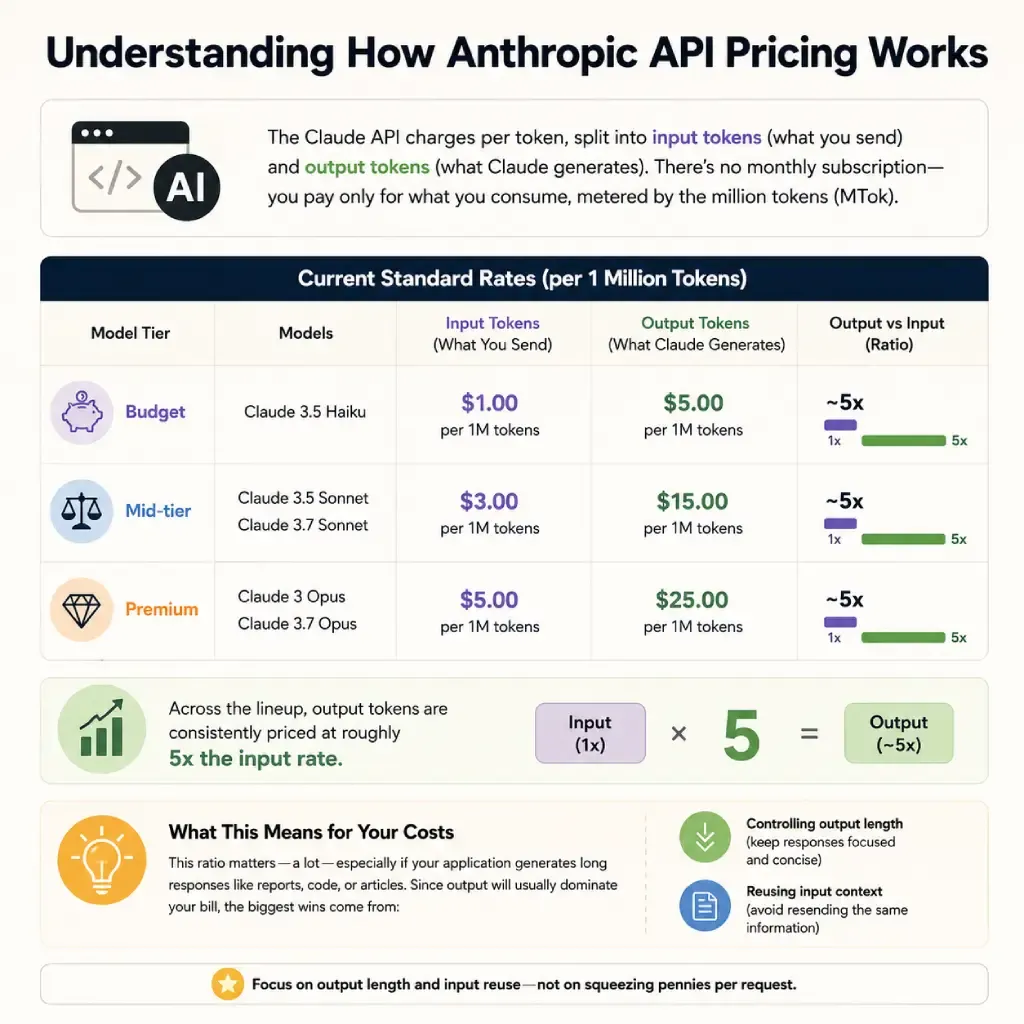
Before optimizing costs, it helps to understand the billing model. The Claude API charges per token, split into input tokens (what you send) and output tokens (what Claude generates). There’s no monthly subscription for API usag you pay only for what you consume, metered by the million tokens (MTok).
Current standard rates span three tiers: Haiku 4.5 sits at the budget end around $1 input / $5 output per million tokens, Sonnet 4.6 sits in the middle around $3 / $15, and Opus-tier models sit at the premium end around $5 / $25. Across the lineup, output tokens are consistently priced at roughly 5x the input rate which matters a lot if your application generates long responses like reports, code, or articles, since output will usually dominate your bill.
Understanding this ratio is the foundation of any Anthropic API costs reducing strategy: the biggest wins usually come from controlling output length and reusing input context, not from squeezing pennies on individual requests.
Use Prompt Caching to Cut Repeated Input Costs
Prompt caching is the single highest-impact lever available, and it’s still underused by most teams. Here’s the idea: if your application sends the same system prompt, tool definitions, or reference documents on every request, you can mark that content as cacheable. The first request pays a modest premium to write it to cache. Every subsequent request that reuses that same prefix reads from the cache at roughly 10% of the standard input price a 90% saving on that portion of the bill.
There are two cache durations to choose from:
5–Minute Ephemeral Cache
Best for interactive sessions where the same system prompt gets reused across a burst of user messages. Cache writes cost about 1.25x normal input price, and cache reads cost about 0.1x.
1-Hour Cache
Better suited to batch pipelines or agents running steadily over a longer window. Cache writes cost about 2x normal input, but the same 0.1x read price applies.
The practical setup is simple: place static content system instructions, tool schemas, reference documents, few-shot examples at the beginning of your prompt, and put the dynamic, per-request content (the actual user message) at the end. That structure lets Anthropic’s caching system recognize and reuse the unchanged prefix automatically.
Batch Non-Urgent Work Through the Message Batches API
If part of your workload doesn’t need a real-time response bulk document classification, evaluation runs, nightly content generation, historical log summarization route it through the Batch API instead of synchronous calls. Anthropic processes batched requests asynchronously (often within a few hours, guaranteed within 24) and bills both input and output tokens at a flat 50% discount, with no minimum volume required to qualify.
The batch discount and prompt caching discount stack. A cached, batched request can end up costing around 5–10% of what the same request would cost at standard, uncached, real-time pricing. For any pipeline where “instant” isn’t a real requirement, this combination is usually the fastest win available.
Route Requests to the Right Model
Not every task needs your most capable and most expensive model. A classification task, a short extraction, or a simple formatting job rarely needs the same horsepower as a complex multi-step reasoning task.
A practical routing pattern looks like this:
- Simple, high-volume tasks(classification, tagging, short extraction, routing decisions) → a Haiku-tier model
- General production workloads(drafting, summarization, most agent tasks, coding assistance) → a Sonnet-tier model
- Complex reasoning, long-horizon agents, high-stakes accuracy→ an Opus-tier model
Because the price gap between tiers can be 5x or more per token, misrouting even a modest share of your traffic to a model more powerful than the task requires adds up fast. If you’re building agentic systems with multiple subtasks, this is closely related to the broader question of measuring whether your AI investment is actually paying off cost-per-outcome, not cost-per-token, is the metric that actually matters.
Manage Context and Output Length Deliberately
Since output tokens cost roughly five times more than input tokens, trimming unnecessary output is one of the most direct ways to shrink a bill. A few concrete habits help:
- Set explicit max_tokensA prompt instruction asking for brevity is a suggestion; an API-level limit is enforced.
- Trim conversation history.Don’t resend an entire multi-turn conversation if only the recent turns are relevant – long context windows are powerful, but every token you send gets billed.
- Avoid retry storms.Uncapped automatic retries on failed calls can quietly multiply your token spend without producing any usable output.
- Watch extended thinking usage.Reasoning tokens are billed as output tokens, so tasks that don’t need deep step-by-step reasoning should generally skip it.
If your workflows involve deciding how much a system should “think” versus react, it’s worth understanding the underlying distinction between model-based and model-free approaches to learning, since that same tradeoff more computation for better decisions, versus faster and cheaper responses shows up directly in how much reasoning you ask a model to do per request.
Monitor Usage Patterns Continuously
Cost optimization isn’t a one-time setup it’s an ongoing practice. Track token consumption by project, environment, and feature so you can spot where spend concentrates. Separate development and staging traffic from production billing so test runs don’t distort your real usage picture. Anthropic’s usage dashboard reports input, output, and cache token counts per request, which is enough to build a rough cost model and catch anomalies before they become a surprise invoice.
Teams building broader AI infrastructure often pair this kind of monitoring with tools like Perplexity for quick research tasks or development frameworks such as AgentKit for application building, reserving the more expensive Claude API calls for the parts of the workflow where quality genuinely matters a pattern that mirrors how logistics and cargo companies have used AI cost-cutting strategies to reserve premium compute for the decisions that actually move the needle.
Frequently Asked Questions
Does the Anthropic API have a free tier?
There’s no ongoing free tier for production usage. New accounts typically start with prepaid credits, and usage is billed per token consumed.
Can prompt caching and batch processing be used together?
Yes. The two discounts stack, and combining them typically produces the deepest cost reduction available on the API.
Which model should I default to for cost control?
For most production workloads, a mid-tier (Sonnet-class) model offers the best balance of capability and price. Route simple, high-volume tasks down to a lighter model, and reserve the top-tier model for genuinely complex reasoning.
Does a longer context window cost more?
Current-generation models with 1M-token context windows bill at the same per-token rate regardless of prompt length there’s no separate long-context premium on these models, though you still pay for every token you actually send.
Is caching worth it for low-volume applications?
Caching pays off once a cached prefix is reused even a couple of times, so it’s worth implementing for almost any application with a repeated system prompt, not just high-volume ones.
Reducing Anthropic API costs doesn’t require compromising on capability it requires using the tools already built into the platform. Prompt caching, batch processing, and thoughtful model routing can, combined, cut your effective spend by well over half. Start with caching, since it’s the lowest-effort, highest-impact change. Then layer in batch processing for anything that can tolerate a delay, and set up model routing so your budget is spent on the tasks that actually need premium reasoning.
Ready to put these Anthropic API costs reducing strategies into practice? Start by auditing one high-traffic endpoint this week implement caching on its system prompt, and measure the difference on your next bill.
