
Today we’re addressing something that affects thousands of businesses worldwide, yet rarely receives the urgent attention it deserves.
Yes, we’re talking about legacy website systems — those aging digital foundations that once felt like investments but now quietly drain revenue, repel customers, and create vulnerabilities that modern competitors simply don’t have to worry about.
Many business owners don’t realize the extent of the damage until a competitor surges ahead, a security breach occurs, or conversion rates nosedive without explanation. In this article, we’ll show you exactly how outdated tech is killing business growth and, more importantly, what you can do about it.
What Are Legacy Website Systems, Exactly?

Before we diagnose the problem, let’s define it clearly.
A legacy website system refers to any digital infrastructure built on outdated technology, unsupported platforms, obsolete code frameworks, or architectures that no longer align with current user expectations or business demands. This could be a website built on an abandoned CMS, a custom-coded platform from a decade ago that only one developer understands, or even a “functional” site running on a PHP version that stopped receiving security patches years ago.
Signs You’re Running a Legacy System
- Your site takes more than 3 seconds to load on mobile
- Integrating new tools (CRMs, payment gateways, analytics) requires complex workarounds
- Your development team hesitates to touch the codebase for fear of breaking something
- Security patches haven’t been applied consistently
- Your site looks and behaves noticeably behind modern competitors
If two or more of those apply to your business, the cost is likely already being measured in lost revenue.
The Hidden Revenue Cost of Outdated Tech Killing Business

This is where the real conversation begins.
A 1-second delay in page load time can reduce conversions by up to 7%, according to widely-cited performance research. For a business generating $500,000 annually through its website, that single second costs $35,000 per year — before factoring in the compounding effect of poor search rankings, higher bounce rates, and reduced customer trust.
Legacy systems create performance debt that accumulates silently. Because the website still “works,” there’s no immediate alarm. But the business is bleeding through:
- Higher maintenance costs— older systems require more developer hours to maintain, debug, and patch
- Opportunity cost— time and budget spent firefighting legacy issues can’t be invested in growth features
- Integration friction— modern marketing, analytics, and automation tools struggle to interface with outdated architectures, forcing expensive custom development
We’ve seen businesses spend more annually maintaining a legacy site than a complete rebuild would have cost. For a deeper look at how operational inefficiencies accumulate over time, our article on website maintenance costs breaks down where those expenses truly originate.
Security Vulnerabilities: The Risk Nobody Talks About Loudly Enough

Legacy website systems are prime targets for cyberattacks — not because hackers are specifically targeting your business, but because outdated software is low-hanging fruit.
When platforms, plugins, or server software reach end-of-life, they stop receiving security updates. Vulnerabilities become publicly known. Automated bots scan the web for sites running these versions and exploit them systematically.
What This Means in Practice
A single successful breach can result in:
- Customer data exposure and the legal liability that follows
- Ransomware that locks your operations entirely
- SEO penalties from Google when your site gets flagged for malicious content
- Permanent reputational damage that no marketing budget can easily reverse
This isn’t theoretical. IBM’s Cost of a Data Breach Report consistently shows average breach costs exceeding $4 million globally — with small and mid-sized businesses disproportionately impacted because they lack the recovery infrastructure of enterprises.
Modernizing your tech stack isn’t just about performance. It’s a business continuity decision.
How Legacy Systems Damage Your Search Rankings and Organic Growth

Google has made its position clear: page experience matters. Core Web Vitals — the set of speed, responsiveness, and visual stability metrics — are active ranking factors. Legacy systems, almost by definition, struggle to meet these benchmarks.
Beyond raw speed, outdated systems often make technical SEO harder to implement:
- Rigid URL structures that can’t be optimized
- Missing schema markup capabilities
- Poor mobile rendering (often entirely absent on legacy builds)
- Inability to implement modern image formats like WebP
- Limited control over canonical tags, structured data, and meta management
Your competitors on modern stacks aren’t just winning on design. They’re ranking higher, loading faster, and converting better — simultaneously. Understanding how AI-powered development approaches are reshaping competitive positioning is worth exploring, particularly in high-velocity industries. Our case study on AI in air cargo illustrates how digital modernization creates measurable operational advantages even in traditionally infrastructure-heavy sectors.
The Integration Problem: When Your Website Can’t Keep Up With Your Business
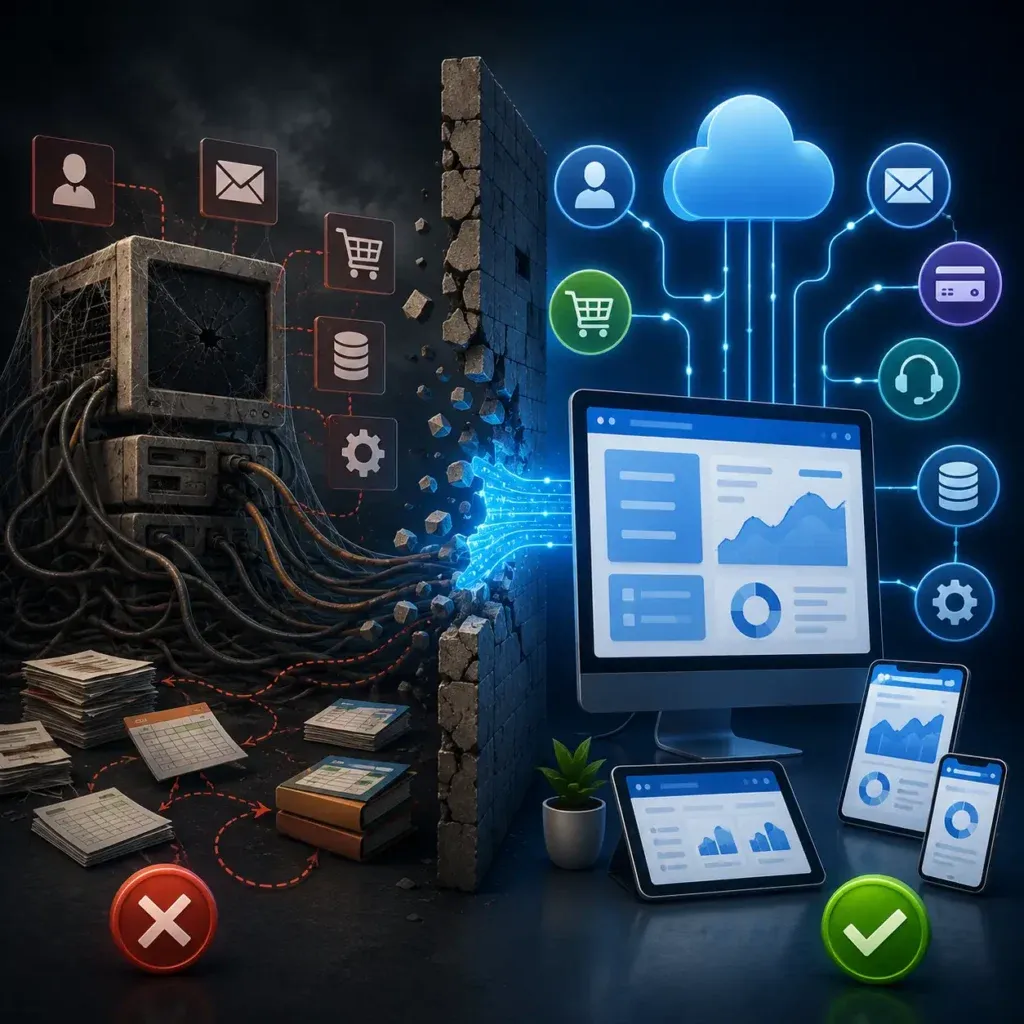
Modern business runs on interconnected tools. CRMs, marketing automation platforms, inventory systems, payment processors, customer support software — these tools work best when they communicate seamlessly.
Legacy website systems create integration walls. APIs don’t align. Data gets siloed. Teams resort to manual exports, spreadsheet workarounds, and copy-paste workflows that introduce errors and consume hours better spent elsewhere.
The Real-World Impact
Consider a mid-sized e-commerce business trying to connect its legacy site with a modern email automation platform. Without clean API support, the integration requires custom middleware, ongoing maintenance, and a fragile data pipeline that breaks every time either system updates. What should be a $200/month tool becomes a $2,000/month problem.
This integration friction also limits your ability to adopt AI-powered tools — which are increasingly defining competitive advantage across industries. Businesses that modernize their digital foundation can deploy AI task automation and AI-driven cost optimization at scale. Those running legacy stacks simply cannot.
What the Modernization Path Actually Looks Like
Modernizing doesn’t always mean rebuilding from scratch — though sometimes it does. The appropriate path depends on your current system, business goals, and technical debt level.
Incremental Modernization
For systems that have salvageable architecture, a phased approach works well: upgrade the CMS, migrate to modern hosting infrastructure, refactor the frontend for performance, and introduce API-first integrations progressively. This distributes cost and minimizes disruption.
Full Rebuild
When the legacy system’s technical debt is too deep, a clean rebuild on a modern stack — React-based frontends, headless CMS architecture, cloud-native hosting — delivers better long-term economics. The upfront investment is recovered through reduced maintenance costs, better performance, and genuine scalability.
Choosing the right development partner is critical here. The wrong team can rebuild a legacy system that simply replicates the old problems in new code. Our guide on finding the right AI development company outlines the evaluation criteria that distinguish capable partners from those who will leave you in the same position two years from now.
FAQ: Legacy Website Systems and Business Impact
Q: How do I know if my website qualifies as a legacy system? If your site runs on unsupported software versions, takes longer than 3 seconds to load on mobile, or requires significant workarounds to connect with modern business tools, it almost certainly qualifies. A technical audit will confirm the specific risk areas.
Q: Is modernizing my website really worth the investment? In most cases, yes — decisively. Reduced maintenance overhead, improved conversion rates, better search visibility, and eliminated security risk typically generate positive ROI within 12 to 18 months of a well-executed modernization project.
Q: Can I just update plugins and themes instead of rebuilding? Sometimes. Surface-level updates address some security vulnerabilities, but they don’t resolve fundamental architectural limitations — performance ceilings, integration constraints, and core framework obsolescence require deeper intervention.
Q: How long does a website modernization project take? Scope varies significantly. A focused performance and security overhaul can complete in 4 to 8 weeks. A full rebuild with custom functionality typically runs 3 to 6 months. Phased approaches can deliver early wins within weeks while the broader work continues.
Q: What’s the biggest mistake businesses make with legacy systems? Waiting. Every month of delay compounds the cost — through security exposure, lost rankings, reduced conversions, and a widening gap between your capabilities and your competitors’. The best time to address a legacy system was last year. The second best time is now.
Conclusion: Your Website Is Either Working for You or Against You
There is no neutral. A legacy website system doesn’t just sit there passively — it actively costs you customers, rankings, security, and the operational flexibility needed to compete in a market where digital experience directly drives revenue.
The businesses winning today are those that treated their digital infrastructure as a strategic asset rather than a sunk cost to maintain indefinitely. They moved faster, integrated smarter tools, and built on foundations that scale.
If your current site reflects decisions made five or more years ago, it’s time to ask honestly: is this system helping us grow, or quietly holding us back?
We’d encourage you to start with a thorough technical audit. Understand exactly what your legacy system is costing you. Then build a modernization roadmap that aligns with your business goals — because the solution isn’t always the most expensive one, but it is always the timely one.
Ready to understand what your current system is really costing you? Reach out to our team for a no-obligation technical assessment. Let’s build something your business can grow into — not out of.
