
Open-source AI models have been moving fast for the last two years, but 2026 feels different. The gap between open-weight and proprietary frontier models has narrowed sharply, with Epoch AI estimating that frontier open-weight models now trail the most capable closed models by only around three months on average. In that environment, Google’s Gemma 4 is not just another release. It is a signal that open AI is becoming practical infrastructure for real products, real devices, and real business workflows.
Google introduced Gemma 4 in early April 2026 as its most capable open model family to date, built from the same research foundation as Gemini 3 and released under the Apache 2.0 license. That combination matters. It means developers are not only getting stronger reasoning and multimodal performance, but also much clearer commercial rights than they had with many earlier “open” releases in the market.
At Think To Share, this is exactly the kind of model shift businesses should watch closely. When a model is powerful enough for agentic workflows, efficient enough for local hardware, and flexible enough for commercial deployment, it changes how companies think about AI automation, AI agents, software products, and cost control.
What is Gemma 4?
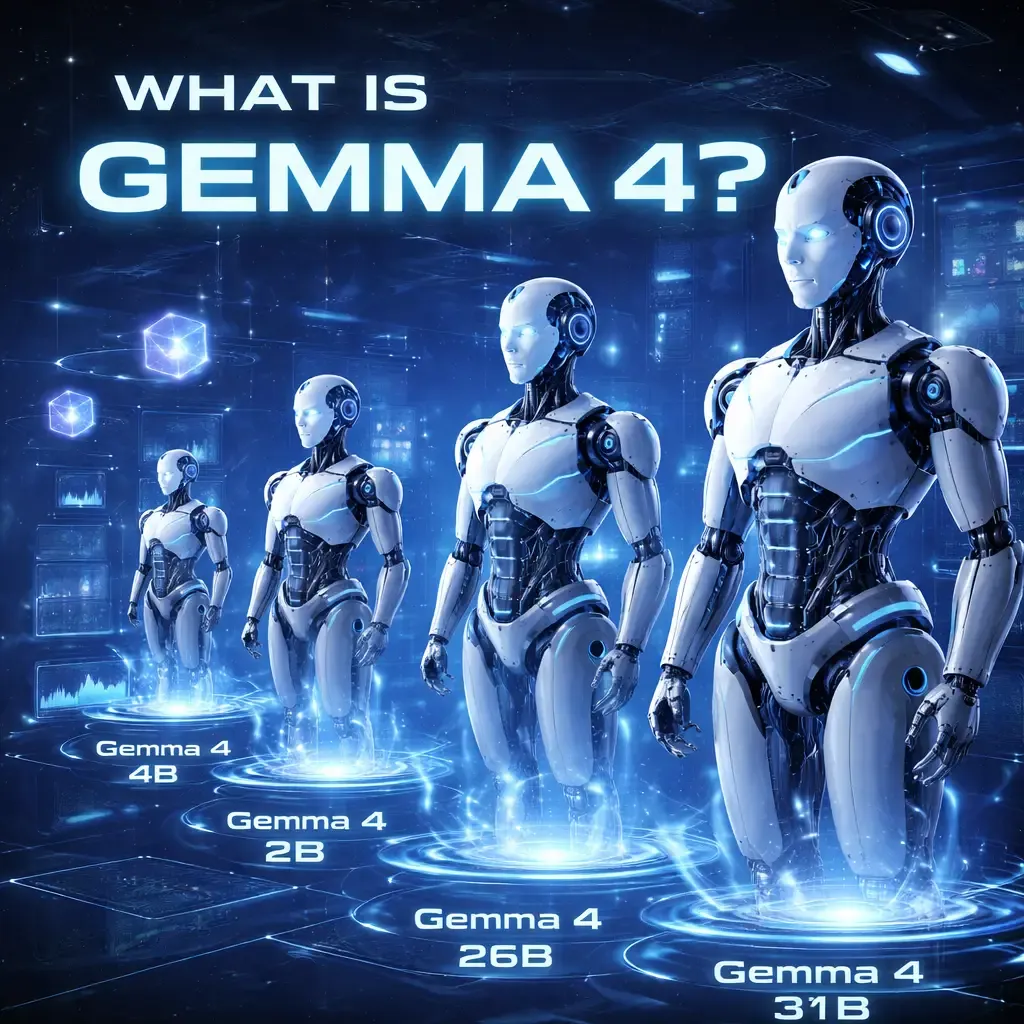
Gemma 4 is Google’s latest open model family for text, reasoning, coding, multimodal understanding, and agentic workflows. The family includes four main variants: E2B, E4B, 26B A4B, and 31B. Google says the smaller models are designed for ultra-mobile, edge, and browser deployment, while the larger models are aimed at local workstation and server-grade use cases.
Google’s official documentation highlights several capabilities that make Gemma 4 stand out:
advanced reasoning, native function calling, structured JSON output, native system prompt support, image and video understanding across the family, audio input on the smaller edge-focused models, and context windows of 128K for the smaller models and up to 256K for the larger ones.
Why Gemma 4 matters so much in 2026
1. It brings real commercial clarity with Apache 2.0
One of the biggest reasons Gemma 4 is a game-changer is not just benchmark performance. It is the licensing shift. Google explicitly released Gemma 4 under Apache 2.0, which is a major improvement for developers and businesses that want fewer restrictions when building commercial AI applications. Google’s open source team says this gives developers more clarity about their rights and responsibilities and helps them build more confidently.
That matters for startups, SaaS companies, enterprise teams, and product builders. Earlier “open” models often came with enough legal uncertainty to slow down adoption. Gemma 4 changes that conversation by making deployment decisions much easier from a licensing perspective.
2. It makes local AI far more practical
Gemma 4 is clearly designed for the local AI era. Google says the family is optimized to run and fine-tune efficiently across a wide hardware range, from Android devices and laptop GPUs to workstations and accelerators. Its smaller E2B and E4B models are specifically positioned for offline, low-latency use on edge devices such as phones, Raspberry Pi, and NVIDIA Jetson Orin Nano.
For businesses, this opens up a very practical set of possibilities:
private copilots, offline field assistants, secure document AI, edge AI in manufacturing environments, and lower-latency AI experiences without fully depending on cloud APIs. That can directly improve privacy, reduce recurring API costs, and lower vendor lock-in.
3. It is built for agentic workflows, not just chat
A lot of open-source AI content still focuses on chatbots. Gemma 4 goes much further. Google highlights native support for function calling, structured JSON output, and system instructions, which are exactly the features developers need when building reliable AI agents and automation flows.
That means Gemma 4 is better aligned with how businesses are actually using AI in 2026:
not just answering prompts, but connecting to tools, calling APIs, generating structured outputs, and automating multi-step workflows. This is one of the biggest reasons it fits so well into AI automation strategies, internal copilots, support systems, and workflow orchestration.
4. It delivers strong capability-per-parameter
Google claims Gemma 4’s larger models rank among the top open models on Arena AI’s leaderboard, with the 31B model at #3 and the 26B model at #6 at launch, while outperforming some much larger models on a capability-per-parameter basis. Google’s model card also shows large gains over Gemma 3 27B across reasoning, coding, science, and benchmark-heavy tasks such as AIME 2026, LiveCodeBench v6, GPQA Diamond, and BigBench Extra Hard.
That is important because businesses do not just want the “largest” model. They want the most useful model they can deploy economically. Better intelligence-per-parameter means better ROI.
5. It is multimodal in a practical way
Gemma 4 supports text and image processing across the family, along with video support and native audio input on the smaller models. Google also emphasizes OCR and chart understanding among the visual strengths.
This makes Gemma 4 more than a text model. It becomes useful for:
document analysis, screen understanding, business dashboards, image-based workflows, spoken input use cases, and visual copilots. For product teams, that means one model family can support more real-world features without jumping across too many disconnected tools.
What makes Gemma 4 different from other open-source AI models?
The open model market in 2026 is crowded. Qwen, Mistral, Llama, DeepSeek, and others all matter. But Gemma 4’s edge is not just raw intelligence. It is the combination of features.
Here is where Gemma 4 feels different:
License plus capability
Many strong open-weight models are technically impressive, but licensing clarity can still be a concern for commercial teams. Gemma 4’s Apache 2.0 release gives it an immediate advantage in business discussions around compliance, redistribution, and productization.
Local-first positioning
Google is not treating local deployment as an afterthought. Gemma 4 is being pushed for Android, edge devices, local coding support, and hardware flexibility from small devices to full workstations.
Agent-ready design
Native function calling and structured output are a big deal in 2026 because the market is rapidly shifting from “ask a chatbot” to “deploy an agent that can do work.” Gemma 4 is clearly built with that future in mind.
Better balance between performance and deployability
Google’s documentation and recent industry analysis both point toward Gemma 4 being especially attractive where teams want strong reasoning without the hardware burden of extremely large frontier models.
Why this matters for businesses, not just developers
The biggest mistake companies make with AI is assuming model selection is purely a technical issue. It is not. Model choice affects infrastructure cost, compliance, latency, privacy, vendor lock-in, customization, and long-term product roadmap.
Gemma 4 changes the conversation for businesses in at least five ways:
Lower operational costs
If you can run more workloads locally or on controlled infrastructure, you may reduce dependency on expensive API-heavy architectures.
Better privacy and governance
Local or self-hosted open models can be a better fit for sensitive internal use cases, especially where document privacy, data residency, or stricter governance matter.
More customization
Open models give teams more room for fine-tuning and workflow-specific optimization. Google explicitly positions Gemma 4 for efficient tuning across different hardware tiers.
Faster product experimentation
Teams can prototype internal copilots, AI-powered dashboards, support assistants, and agentic automations faster when they are not blocked by restrictive model terms.
Stronger AI product ownership
This is the long-term advantage. If your business depends on AI, owning more of your stack matters. Gemma 4 strengthens that option.
Best use cases for Gemma 4 in 2026
Gemma 4 is especially compelling for:
AI agents and workflow automation
Its native function-calling and structured output support make it well-suited for agentic systems that connect with CRMs, ERPs, ticketing systems, APIs, and internal business tools.
Local coding copilots
Google is actively positioning Gemma 4 for local-first code assistance, including Android Studio support.
On-device AI apps
The smaller models are designed for offline and near-zero latency deployment on edge devices.
Document intelligence
Long context windows, OCR-related visual strengths, and multimodal input support make Gemma 4 useful for summarization, extraction, classification, and internal knowledge assistants.
Enterprise copilots
Companies can build internal assistants for HR, operations, finance, support, or analytics with more control over cost and deployment patterns.
Is Gemma 4 truly “open source”?
This is where precision matters. In AI, people often say “open source” when they mean “open-weight.” Gemma 4 is being marketed by Google as an open model, and Google has applied the Apache 2.0 license to Gemma 4, which gives much clearer open-source-style commercial rights than many competing models. However, in broader AI debates, some people still distinguish between open weights and fully open-source systems that also disclose full datasets and training pipelines.
For most businesses, the practical takeaway is simple:
Gemma 4 is far easier to adopt commercially than many earlier open releases, and that is what makes it strategically important.
The Think To Share take
From our perspective, Gemma 4 matters because it aligns with where modern AI implementation is heading.
Businesses in 2026 do not just want “the smartest model.” They want:
- an AI model they can actually deploy,
- a model that supports automation and agents,
- a model that works across different hardware setups,
- a model with clearer licensing,
- and a model that keeps future product decisions more flexible.
Gemma 4 checks a rare combination of those boxes.
For companies building AI-powered products, internal tools, support automation, AI copilots, or edge AI solutions, Gemma 4 is one of the most important open model releases to evaluate this year.
Gemma 4 is a game-changer because it moves open AI forward in the areas that matter most in 2026: licensing clarity, local deployment, agentic readiness, multimodal capability, and strong performance without extreme hardware demands. Google did not just release another model. It released a more usable blueprint for how open AI can fit into production systems.
If your business is exploring AI automation, AI agents, or custom AI product development, this is the kind of model shift worth acting on early.
