
If you’ve been trying to decide between Gemini 3 Pro and Claude Sonnet 4.5, you’re not alone. Both models launched within weeks of each other in late 2025, and both are still go-to choices for developers, agencies, and businesses building AI-powered products in 2026. We work with these models daily at our studio, and we’ve noticed that the “which one is better” question doesn’t really have a single answer – it depends entirely on what you’re building.
In this guide, we’ll walk through the difference between Gemini 3 Pro and Claude Sonnet 4.5 across the metrics that actually matter: coding ability, context window size, pricing, multimodal capability, and agentic reliability. By the end, you’ll know exactly which model fits your workflow.
Gemini 3 Pro vs Claude Sonnet 4.5: Quick Overview
Gemini 3 Pro is Google DeepMind’s flagship reasoning model, announced on November 18, 2025, built with agentic AI, multimodal understanding, and deep reasoning at its core. Claude Sonnet 4.5, released by Anthropic around the same time, is positioned as Anthropic’s strongest coding and agentic model, with particular strength in tool use and long-running autonomous tasks.
Here’s the short version: Gemini 3 Pro tends to win on raw benchmark scores and multimodal reasoning, while Claude Sonnet 4.5 tends to win on coding reliability and day-to-day developer experience. Neither model is a clear knockout – this is a genuine two-horse race, and your use case should decide the winner.
Coding Performance: Where Each Model Pulls Ahead
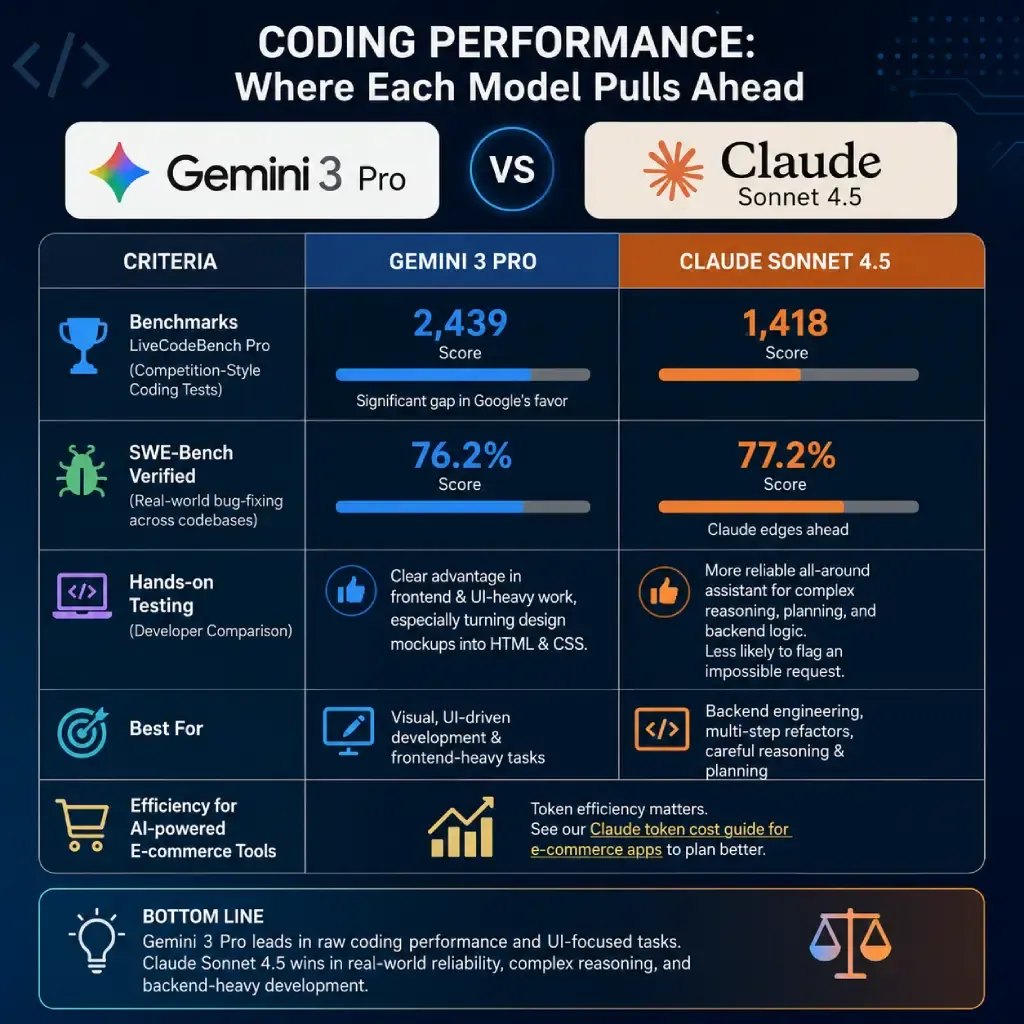
Coding is usually the deciding factor for teams comparing these two models, so let’s start there.
On competition-style coding tests, Gemini 3 Pro scored 2,439 on LiveCodeBench Pro compared to Claude Sonnet 4.5’s 1,418 – a significant gap in Google’s favor. But benchmarks don’t tell the whole story. On SWE-Bench Verified, which measures real-world bug-fixing across actual codebases, Claude edges ahead with a score of 77.2% versus Gemini’s 76.2%.
In hands-on testing, the difference becomes more nuanced. One developer comparison found that Gemini 3 Pro has a clear advantage in frontend and UI-heavy work, particularly when turning design mockups into working HTML and CSS. That same review noted that Claude 4.5 remains the more reliable all-around assistant for complex reasoning, planning, and backend logic, and is generally regarded as more likely to flag an impossible request rather than guess.
If your work leans heavily toward visual, UI-driven development, Gemini 3 Pro’s multimodal strength gives it an edge. If you’re doing backend engineering, multi-step refactors, or need a model that reasons carefully before acting, Sonnet 4.5 is the safer bet. For teams building AI-powered e-commerce tools where token efficiency also matters, our Claude token cost guide for e-commerce apps breaks down how coding-focused workloads translate into real budget numbers.
Context Window and Multimodal Capabilities
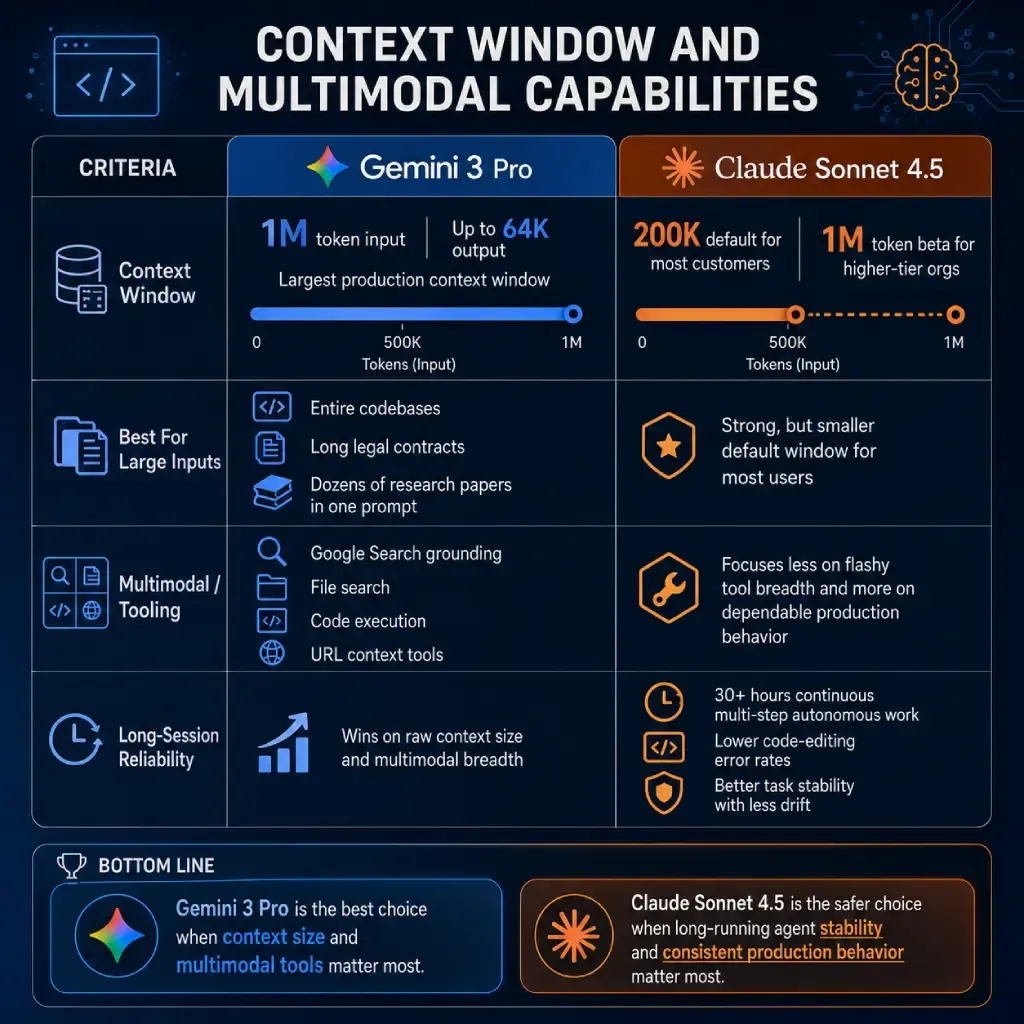
This is one area where the gap is more clear-cut. Gemini 3 Pro offers a 1 million token input context window with up to 64,000 tokens of output – the largest production context window available at launch. Claude Sonnet 4.5, by comparison, defaults to a 200,000 token context window for most customers, with a 1 million token option available in beta for higher-tier organizations.
Practically, that means Gemini 3 Pro is the more natural choice if you’re regularly feeding it entire codebases, lengthy legal contracts, or dozens of research papers in a single prompt. Google’s own developer documentation confirms this is a core design goal, noting Gemini 3 supports Google Search grounding, file search, code execution, and URL context tools alongside its large context window.
Claude Sonnet 4.5 counters with something less flashy but arguably more valuable for production systems: consistency. Anthropic highlights 30-plus hours of continuous multi-step autonomous work in internal evaluations, along with lower code-editing error rates than prior generations. If your application depends on an agent staying on task across a long session without drifting or hallucinating a fix, that stability matters more than raw context size.
Pricing Difference between Gemini 3 Pro and Claude Sonnet 4.5
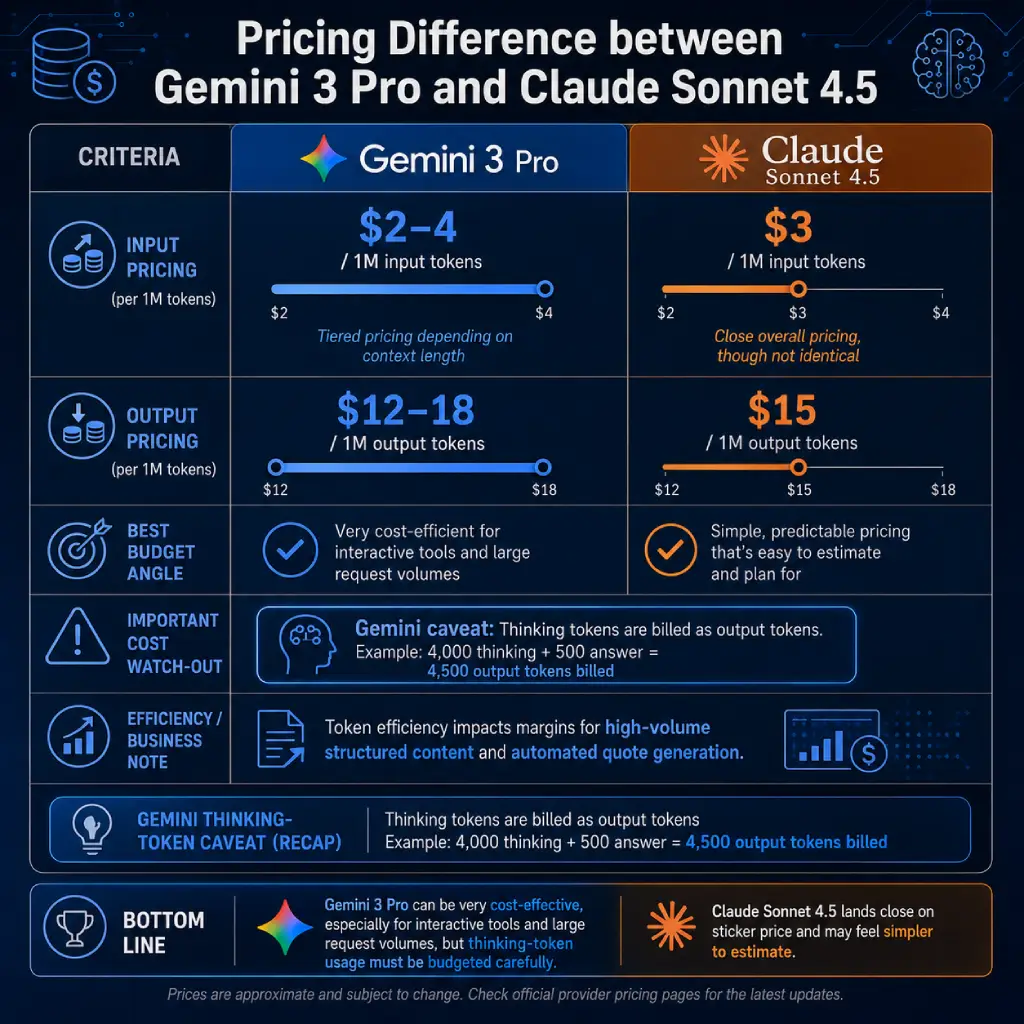
Budget is often the tiebreaker, and here the two models land close together, though not identical.
Gemini 3 Pro uses a tiered pricing structure of roughly $2-4 per million input tokens and $12–18 per million output tokens depending on context length. Claude Sonnet 4.5 runs at approximately $3 per million input tokens and $15 per million output tokens, which independent analysis describes as extremely cost-efficient for interactive tools handling large request volumes, especially when combined with prompt caching.
One important gotcha with Gemini: thinking tokens are billed as output tokens at the standard rate, so a model reasoning through 4,000 tokens before writing a 500-token answer bills for 4,500 output tokens total. If you’re building an agentic workflow that leans on high thinking levels, factor that into your cost projections rather than budgeting off the sticker price alone.
For businesses generating structured content or automated quotes at scale, token efficiency directly impacts margins our AI quote generation guide covers how to structure prompts to keep output token counts (and therefore costs) under control regardless of which model you choose.
Agentic Workflows and Real-World Reliability
Both models are marketed heavily around “agentic” capability the ability to plan, execute, and self-correct across multi-step tasks without constant human intervention.
Independent testing found that Gemini 3 Pro tends to produce more complete responses than Claude Sonnet 4.5 when paired with Gemini CLI, while noting that Claude Code with Sonnet 4.5 still offers the most stable experience without capacity issues. That reliability point is worth taking seriously if you’re deploying a customer-facing agent a model that occasionally hits capacity limits or produces incomplete output can quietly damage user trust.
A broader multi-model comparison summed up the trade-off well: Sonnet 4.5 feels tuned for IDE-like workflows involving quick iterative edits and conversational debugging, while Gemini 3 Pro shines when code is only part of the picture and you also need to reason about logs, diagrams, documentation, or media in the same context. If you’re weighing Sonnet 4.5 against Anthropic’s own higher tier, our breakdown of Claude Opus 4.7 vs Opus 4.6 differences is a useful companion read for understanding where Sonnet sits in Anthropic’s lineup.
Which One Should You Choose?
Here’s our practical recommendation, based on actual project needs rather than benchmark bragging rights:
Choose Gemini 3 Pro if:
- You need a 1M-token context window as a default, not an add-on
- Your work is UI, frontend, or multimodal-heavy (images, video, screenshots)
- You’re already embedded in the Google Cloud or Vertex AI ecosystem
- You want the most cost-efficient option for large-context, high-volume workloads
Choose Claude Sonnet 4.5 if:
- Backend logic, multi-step refactors, and complex reasoning are your priority
- You need dependable long-horizon agent behavior without babysitting
- You’re running production systems where consistency outweighs peak benchmark scores
- You want a model tuned specifically for coding assistants and IDE workflows
Many teams we’ve worked with don’t pick just one — they run Sonnet 4.5 as the default reasoning engine and bring in Gemini 3 Pro for large-context research or visual tasks. That hybrid approach is increasingly common as both companies keep shipping updates.
Frequently Asked Questions
Is Gemini 3 Pro better than Claude Sonnet 4.5 for coding?
It depends on the task. Gemini 3 Pro scores higher on competition-style coding benchmarks like LiveCodeBench Pro, while Claude Sonnet 4.5 edges ahead on SWE-Bench Verified, which measures real-world bug fixing. For UI and frontend work, Gemini tends to pull ahead; for backend logic and multi-step reasoning, Claude tends to be more reliable.
What is the main difference between Gemini 3 Pro and Claude Sonnet 4.5’s context windows?
Gemini 3 Pro ships with a 1 million token input context window by default, while Claude Sonnet 4.5 defaults to 200,000 tokens, with a 1M option available to select customers in beta.
Which model is cheaper — Gemini 3 Pro or Claude Sonnet 4.5?
They’re close. Gemini 3 Pro starts around $2 input/$12 output per million tokens, while Sonnet 4.5 runs closer to $3 input/$15 output. Gemini can work out cheaper for very large context requests, but thinking tokens add hidden cost on complex tasks.
Can I use both models together?
Yes, and many production teams do — using Sonnet 4.5 for coding and reasoning-heavy tasks, and Gemini 3 Pro for large-document analysis or multimodal work.
Which model is better for building AI agents?
Claude Sonnet 4.5 has a stronger reputation for long-horizon agent stability and lower error rates in production, while Gemini 3 Pro offers deeper native tool integration through Google’s ecosystem.
There’s no universal winner in the Gemini 3 Pro vs Claude Sonnet 4.5 debate — and honestly, that’s good news for anyone building AI products right now. Competition between these two labs keeps driving down prices and pushing capabilities forward. The right move is to match the model to the job: Gemini 3 Pro for scale and multimodal reach, Claude Sonnet 4.5 for dependable, coding-first agent work.
If you’re planning an AI integration and want help deciding which model — or combination of models — fits your product, our team at ThinkToShare works with both Claude and Gemini APIs daily and can help you build something that actually ships. Get in touch and let’s talk through your use case.
