
Today we’re tackling one of the most practical questions developers and product teams ask before integrating AI into their projects: how much will this actually cost?
If you’re building a basic e-commerce shopping app and considering Claude as your AI backbone – whether for product recommendations, search, customer support, or order summaries – understanding token cost estimation isn’t optional. It’s the difference between a profitable AI feature and one that quietly bleeds your budget.
In this guide, we’ll walk through exactly how Claude token cost estimation works, what inputs and outputs look like in a real e-commerce context, and how to calculate realistic monthly costs before you write a single line of production code.
What Is a Token and Why Does It Matter for Cost?
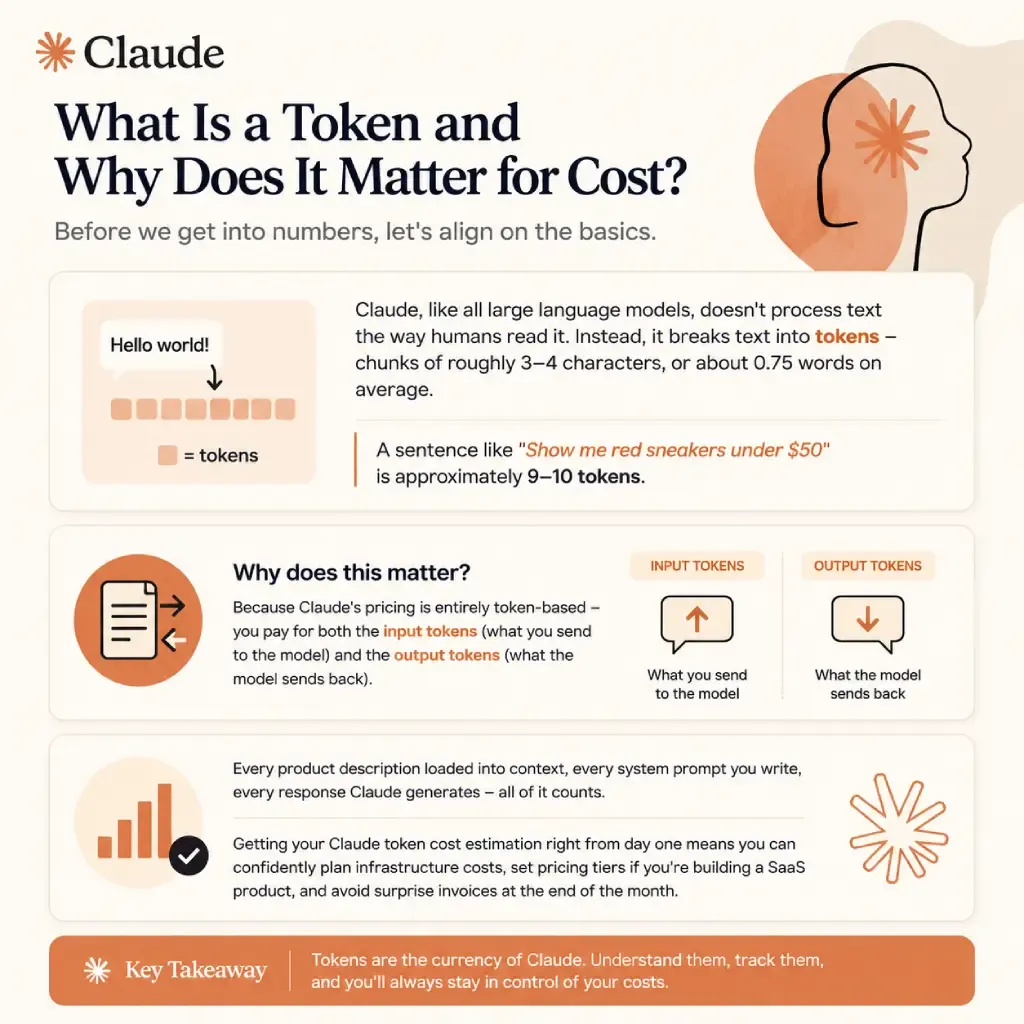
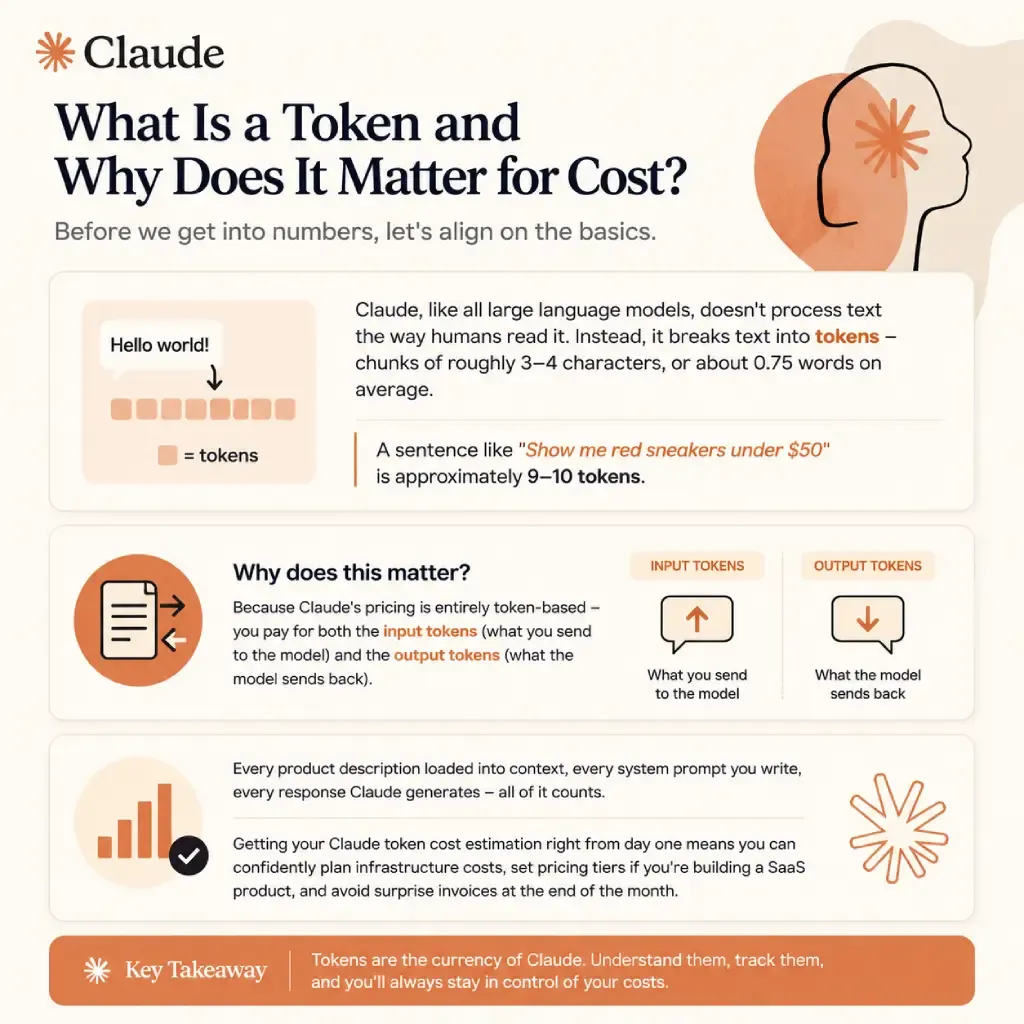
Before we get into numbers, let’s align on the basics.
Claude, like all large language models, doesn’t process text the way humans read it. Instead, it breaks text into tokens – chunks of roughly 3-4 characters, or about 0.75 words on average. A sentence like “Show me red sneakers under $50” is approximately 9–10 tokens.
Why does this matter? Because Claude’s pricing is entirely token-based – you pay for both the input tokens (what you send to the model) and the output tokens (what the model sends back). Every product description loaded into context, every system prompt you write, every response Claude generates – all of it counts.
Getting your Claude token cost estimation right from day one means you can confidently plan infrastructure costs, set pricing tiers if you’re building a SaaS product, and avoid surprise invoices at the end of the month.
Claude’s Current Pricing Structure (What You Need to Know)
Anthropic prices Claude models differently based on capability tier. As of mid-2026, the most commonly used models for production app development fall into a few tiers – with Claude Sonnet sitting at the sweet spot of capability and cost for most e-commerce use cases.
Here’s a simplified framework for how to think about the pricing structure:
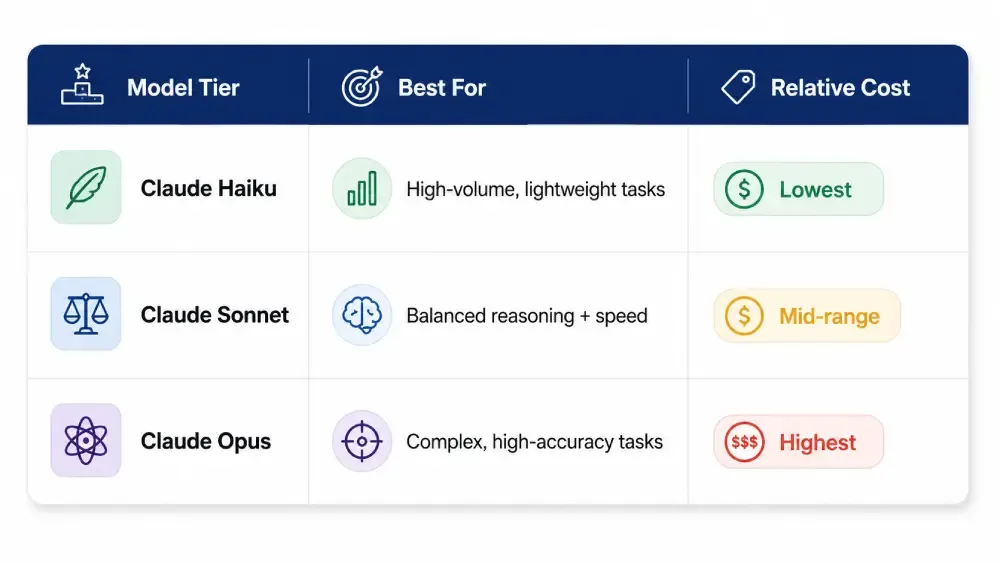
For a basic e-commerce app, Claude Sonnet typically offers the best balance. It handles product Q&A, search intent parsing, and cart recommendations well – without the cost overhead of Opus.
For a deeper comparison of model capabilities, see our breakdown of Claude Opus 4.7 vs Opus 4.6 differences to understand where the performance tiers actually diverge.
Breaking Down a Basic E-Commerce App’s AI Touch Points
A “basic” e-commerce shopping app isn’t as simple as it sounds when you start mapping Claude’s involvement. Let’s define the typical AI-assisted interactions that drive token consumption:
1. Product Search & Intent Parsing
A user types “lightweight running shoes for flat feet, size 10” – Claude interprets the query, maps it to filters, and returns structured output.
Typical tokens: 150-300 input / 100-200 output per query
2. Product Description Generation or Summarization
If Claude is generating or condensing product descriptions dynamically, each call includes a product data payload plus a generation prompt.
Typical tokens: 300-600 input / 200-400 output per product
3. Conversational Shopping Assistant
A chat widget where users ask questions like “Does this jacket come in navy?” or “What’s your return policy for sale items?”
Typical tokens: 200-800 input (including conversation history) / 150-400 output per message
4. Order Confirmation Summaries
Claude generates a personalized order summary or upsell message post-checkout.
Typical tokens: 200-350 input / 150-250 output per transaction
5. System Prompts (Often Overlooked)
Every API call carries your system prompt – the instructions that define Claude’s behavior. A well-written system prompt for an e-commerce assistant typically runs 300–600 tokens and is included in every single request.
This is one of the most common places developers underestimate costs. A 500-token system prompt sent with 10,000 daily queries = 5 million tokens of overhead per month, before any user input.
Claude Token Cost Estimation: A Real E-Commerce Scenario
Let’s run a concrete example for a store with moderate traffic: 1,000 daily active users, each making an average of 4 AI-assisted interactions per session.
Daily interaction volume: 4,000 API calls
Per-call token estimate (Sonnet tier):
- System prompt: 450 tokens (input)
- User query + context: 350 tokens (input)
- Claude response: 250 tokens (output)
- Total per call: ~800 input + 250 output = 1,050 tokens
Daily token consumption:
- Input: 4,000 × 800 = 3,200,000 tokens
- Output: 4,000 × 250 = 1,000,000 tokens
Monthly token consumption (30 days):
- Input: ~96,000,000 tokens
- Output: ~30,000,000 tokens
At Sonnet pricing (check Anthropic’s current pricing page for live rates, as these update), you can now multiply your token volumes by the per-million-token rate for input and output respectively. Output tokens are typically priced 3–5x higher than input tokens – a detail many first-time estimators miss.
This is also where measuring your actual AI ROI becomes critical. Our guide on measuring AI ROI walks through how to tie these costs back to conversion lift and revenue impact.
5 Practical Strategies to Reduce Claude Token Costs in E-Commerce
Understanding your cost baseline is only half the equation. Here’s how experienced teams keep Claude token cost estimation accurate and keep the bills lean:
- Cache your system prompt. Anthropic supports prompt caching, which allows you to cache static prompt content and dramatically reduce input token charges on repeated calls. For e-commerce apps where the system prompt rarely changes, this alone can cut input costs by 30–50%.
- Trim context aggressively. Don’t send full conversation history on every turn. Summarize or truncate older messages. A 10-turn chat history can balloon to 3,000+ input tokens if not managed.
- Use the right model for the right task. Route simple FAQ lookups or intent classification to Claude Haiku, and reserve Sonnet or Opus only for tasks requiring richer reasoning. This tiered routing approach is a hallmark of mature AI architecture – something we explore in detail in our guide on AgentKit 2.0 for application development.
- Set output token limits. If Claude only needs to return a product filter set (not a paragraph), cap max_tokens accordingly. Uncapped outputs are one of the most common sources of unexpected cost spikes.
- Instrument and monitor from day one. Log every call’s token count in development. Build a dashboard. Cost surprises in production almost always trace back to assumptions made during development that nobody validated with real data.
Claude Token Cost Estimation for E-Commerce App: Scaling Considerations
One important nuance: token costs don’t scale linearly with user growth the way server costs might. As your catalog grows, so do your context payloads. As conversation depth increases, so does history size. As you add personalization layers, system prompts get longer.
The smart approach is to re-estimate at each scale milestone – when you go from 1K to 10K daily active users, recalculate with actual logged token counts from your 1K baseline, not just linear multiplication.
For teams planning to build this into a full mobile experience, our mobile app development services page covers how we approach AI cost architecture as part of the broader build – not as an afterthought.
FAQ: Claude Token Cost Estimation for E-Commerce
Q: How many tokens does a typical product page description use?
A product description of 150–200 words is approximately 200–270 tokens. If you’re sending multiple products in one context window for comparison, multiply accordingly and add your system prompt overhead.
Q: Is it cheaper to use Claude for search or a traditional search engine?
For simple keyword matching, traditional search (Elasticsearch, Algolia) is far cheaper. Claude adds value when you need semantic understanding — interpreting ambiguous queries, handling natural language, or blending search with recommendations. The cost is justified when it demonstrably improves conversion.
Q: What’s the single biggest token cost mistake e-commerce developers make?
Forgetting that the system prompt is included in every request. A 600-token system prompt sent 100,000 times a month = 60 million tokens of cost that has nothing to do with your users’ actual queries.
Q: Can I estimate costs before building anything?
Yes — and you should. Map your user journeys, estimate interactions per session, write a draft system prompt, and mock 5–10 representative API calls to measure average token usage. This gives you a defensible cost model before any infrastructure investment.
Q: Does Anthropic offer any cost controls or budget caps?
Anthropic’s API console allows you to monitor usage and set alerts. Prompt caching, model routing, and max_tokens limits are your primary cost levers at the application level.
Conclusion: Build with Confidence, Not Cost Anxiety
Claude token cost estimation for your e-commerce app doesn’t have to be a guessing game. By understanding how tokens are counted, mapping your app’s AI touch points, running a realistic volume calculation, and applying smart optimization strategies from the start, you can build AI-powered shopping experiences that are both impressive and financially sustainable.
The teams that get this right share one thing in common: they treat token costs as a first-class engineering concern, not a billing footnote.
Ready to start building? Our team works with product teams at every stage of AI integration — from architecture and cost modeling to full mobile app development. Reach out and let’s map out what your e-commerce AI implementation actually needs to cost.
