
Imagine waking up to a dashboard where your leads are already sorted, follow-up emails have been sent, invoices are generated automatically, and your team is focused entirely on high-value creative work. For years, automation was a luxury reserved for tech giants with massive engineering budgets. Today, it’s a baseline requirement for staying competitive.
But as a business owner or operations leader, you have to ask the tough question: Is business automation worth the investment? With software subscriptions piling up and the initial setup requiring both time and capital, calculating your potential business automation ROI is essential before diving in. This comprehensive guide will break down the true costs, tangible benefits, and actual returns of automating your workflows so you can make an informed, data-driven decision.
What Does Business Automation Actually Mean Today?
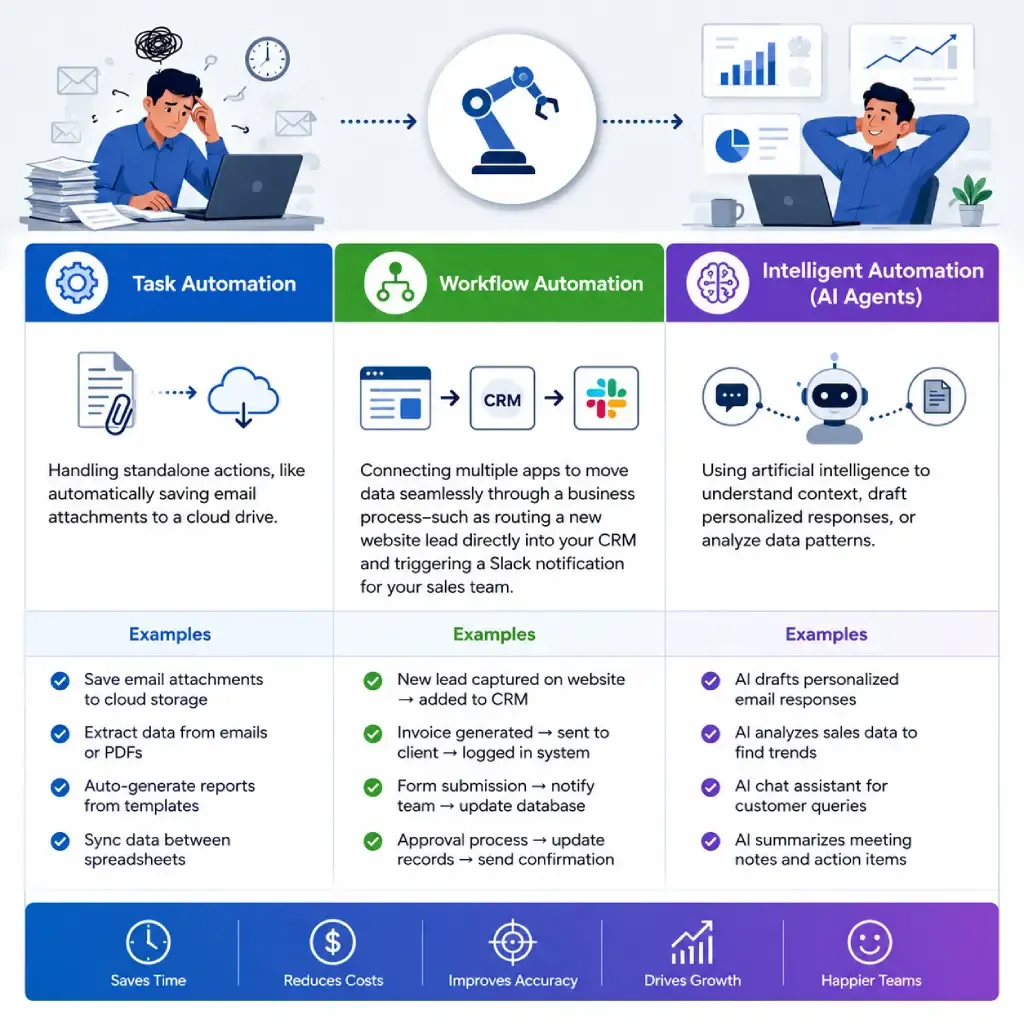
Before looking at the financial returns, we need to clarify what modern automation looks like. It is no longer just about rigid, repetitive data entry. In 2026, automation bridges the gap between simple tasks and intelligent decision-making.
Generally, automation falls into three main categories:
-
Task Automation: Handling standalone actions, like automatically saving email attachments to a cloud drive. Learn more about how this saves daily minutes in our breakdown of AI task automation for business.
-
Workflow Automation: Connecting multiple apps to move data seamlessly through a business process-such as routing a new website lead directly into your CRM and triggering a Slack notification for your sales team.
-
Intelligent Automation (AI Agents): Using artificial intelligence to understand context, draft personalized responses, or analyze data patterns. To see how these advanced systems stack up against traditional setups, check out our AI agents vs. workflow automation comparison.
The Core Question: Is Business Automation Worth the Investment?
The short answer is yes, but with a crucial caveat: it is worth it if it solves a specific, repeatable bottleneck.
To determine if a process is worth automating, apply the Rule of Consistency. If a task is performed multiple times a day, follows a predictable set of rules, and takes your team away from revenue-generating activities, it is a prime candidate for automation.
When done right, the investment shifts your business from a reactive state (putting out daily operational fires) to a proactive state (focusing on strategy, client relationships, and scaling). The value isn’t just in the software you buy; it’s in the human capital you unlock.
How to Calculate Your Business Automation ROI
Calculating your business automation ROI involves looking beyond the price tag of a software subscription. You need a clear formula to balance your upfront costs against long-term gains.
1. Identify the Total Cost of Investment (TCO)
Your initial investment includes:
-
Software licensing or subscription fees.
-
Setup and implementation costs (whether hiring an agency or building internally).
-
Training time for your team to adapt to the new system.
2. Measure the Time and Resource Savings
Calculate the cost of the manual process as it stands today:
For example, if an operations manager earning ₹500/hour spends 10 hours a week manually copying lead data and sending follow-ups, that single process costs your business ₹260,000 annually in lost time. If an automated workflow reduces that time to zero for a software cost of ₹30,000 a year, your net savings are substantial.
3. Factor in Strategic Value
Not all returns show up on a spreadsheet immediately. True ROI also factors in:
-
Error Reduction: Eliminating manual data entry mistakes that cost money or damage client trust.
-
Speed to Market: Responding to customer inquiries in seconds rather than hours, which directly increases conversion rates.
High-Return Areas to Automate First
If you want to see a rapid return on your investment, avoid trying to overhaul your entire business overnight. Focus on these high-impact departments first:
Customer Service and Support
Inquiry response times can make or break a business. Implementing smart systems to handle common FAQs, route complex tickets, and manage instant triage drastically lowers operational stress. Explore the latest strategies in our guide to AI tools for customer service in 2026 to see how modern support teams scale without bloating their headcount.
Sales and Lead Nurturing
Automating the lead pipeline ensures no prospect falls through the cracks. Systems can instantly capture leads from social media or landing pages, log them into your CRM, send a tailored introductory email, and schedule follow-ups based on user behavior.
Operations and Custom Workflows
Sometimes off-the-shelf software doesn’t fit your unique business logic. Modern development frameworks allow companies to build highly customized, lean automation setups without massive enterprise software fees. For a practical look at building tailored internal tools efficiently, see our walkthrough on business processes automation using Replit.
Common Pitfalls That Kill Automation ROI
While the benefits are clear, many businesses still lose money on automation. Knowing what to avoid will safeguard your investment.
-
Automating a Broken Process: If your underlying workflow is chaotic, automating it will only speed up the chaos. Document and optimize the manual steps before writing a single line of code or buying software.
-
Over-Engineering: Don’t build a massive, multi-tiered automation system for a task that only happens once a month. Keep it lean and scale the complexity as your transaction volume grows.
-
Ignoring Team Adoption: Software only works if your team uses it. Involve your staff early in the process, gather their feedback on daily friction points, and provide clear training.
FAQs About Business Automation Investment
How long does it typically take to see a positive business automation ROI?
Most businesses see a return on time within the first 30 to 60 days of deploying a well-planned workflow. Financial ROI typically stabilizes within 3 to 6 months, depending on the complexity of the initial setup and development costs.
Can small businesses afford automation, or is it just for large enterprises?
Modern cloud tools and modular development platforms have made automation incredibly accessible. Small businesses often see a higher relative impact because freeing up just 5–10 hours a week allows a small team or solo founder to focus entirely on closing new revenue.
Will automation replace my staff?
The goal of business automation is to eliminate tasks, not people. By removing administrative drag, data entry, and repetitive follow-ups, your team can pivot to high-value roles like strategy, client relationship management, and creative problem-solving.
When evaluating if business automation is worth the investment, the risk rarely lies in the technology itself. Instead, it lies in how strategically it is applied. When you target high-friction, repetitive tasks, you don’t just save money—you build an agile, scalable infrastructure capable of sustainable growth.
Ready to eliminate operational bottlenecks and scale your workflows efficiently? Explore tailored development, growth strategies, and automation architecture designed for your unique business needs at ThinkToShare. Let’s build systems that work for you, so you can focus on what matters most.
