
One of the most popular buzzwords ever in the world of technology, right after AI, is blockchain, along with other similar words such as crypto. But what exactly is blockchain in the context of a service?
In this blog, we are going to understand how this very popular word by the name of blockchain, in the world of crypto, is becoming quite a popular and transformative force when it comes to multiple industries.
Every industry out there, whether it is the real estate industry or the finance industry, or even the healthcare industry, is very eager to adopt this technology of excellent potential.
That is why in this beginner’s guide, we will understand what exactly is blockchain in the context of a service, Blockchain-as-a-Service (BaaS) and we will also understand the benefits of using BaaS.
Additionally, we will understand what the real-world use cases of Blockchain-as-a-Service (BaaS) and much more.
So, let’s begin by understanding what BaaS is.
What Is Blockchain-as-a-Service (BaaS)?
Blockchain-as-a-Service (BaaS) is primarily a third-party creation intended to help companies build blockchain applications.
It is a cloud-based solution that helps different companies get access to the environment in order to build and host as well as operate different blockchain applications and other smart contracts.
The service aspect of Blockchain-as-a-Service (BaaS) is the fact that third-party companies provide this development environment as a service, which helps the client companies develop blockchain applications without having to invest in their own underlying blockchain infrastructure.
It has a lot of parallels with Software-as-a-Service (SaaS), but instead of providing software as a service, the third-party companies offer blockchain tools and infrastructure, as well as cloud storage and blockchain-related services as a service.
The service provider or the BaaS platform handles all the technical complexities and elements of that blockchain environment network. This means that they help in everything that includes:
- Setting up nodes
- Ensuring network uptime
- Security monitoring
- Data storage and backup
- Performance analytics
While you, as the user, can simply interact with the blockchain network through simple dashboards and a lot of other choices, such as APIs and SDKs, without any worry about setting up the infrastructure yourself.
Key Takeaways About Blockchain-as-a-Service (BaaS)
Before investing in a blockchain solution, it helps to understand the core value of Blockchain-as-a-Service (BaaS). In simple terms, BaaS allows businesses to use cloud-based blockchain networks without building and maintaining the entire infrastructure themselves. Instead of spending heavily on backend setup, companies can focus on creating business-ready blockchain applications.
Here are the key takeaways:
- BaaS lets businesses build, host, and operate blockchain applications without managing the technical backend.
- It works much like a web hosting provider, but for blockchain infrastructure.
- A BaaS provider usually manages nodes, security monitoring, uptime, data backups, and performance management.
- It helps accelerate blockchain adoption by reducing technical complexity and lowering entry barriers.
- BaaS is especially useful for enterprises exploring smart contracts, enterprise blockchain solutions, supply chain systems, digital identity, and secure data sharing.
How Does Blockchain-as-a-Service Work?
Blockchain-as-a-Service works on a model similar to other cloud services. A third-party provider sets up and manages the blockchain environment, while the client company uses that environment to develop, test, and deploy blockchain applications.
A typical BaaS workflow looks like this:
- The provider sets up the blockchain infrastructure.
- The business chooses the required framework, network type, and use case.
- Developers build smart contracts and blockchain applications using APIs, SDKs, and dashboards.
- The provider handles hosting, maintenance, bandwidth, security, node management, and scaling.
- The business focuses on product innovation and business logic instead of infrastructure operations.
This model is one of the biggest reasons why blockchain platform as a service is becoming attractive for startups and enterprises. It removes the heavy lifting involved in blockchain deployment and makes experimentation faster, safer, and more cost-efficient.
Benefits of Blockchain-as-a-Service (BaaS)
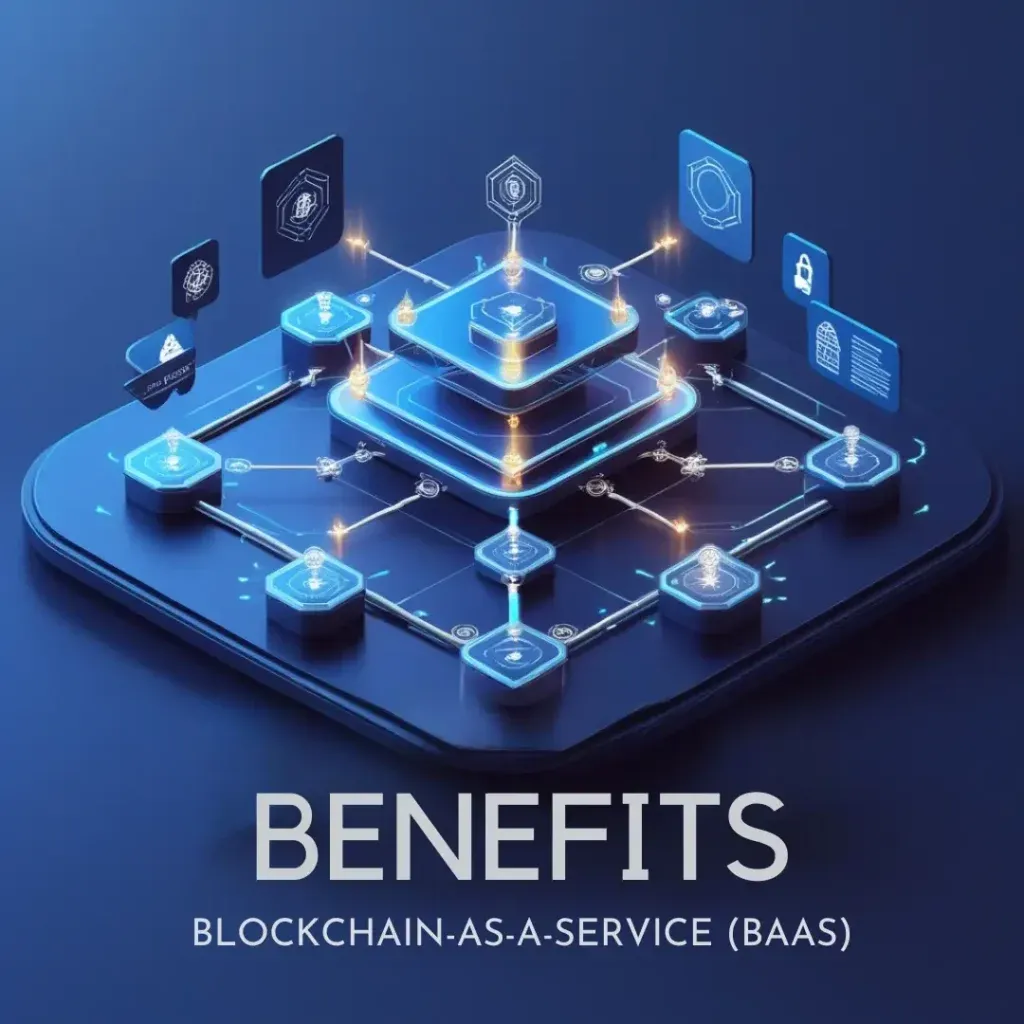
Cost-Effective
Setting up your own blockchain network and infrastructure can be very costly, especially for a company that might be just looking to explore the world of blockchain for the first time.
When it comes to investing in blockchain, you would ideally want your capital to be spent in the development process and not the upfront investment. This is where Blockchain-as-a-Service (BaaS) by providing you with a very cost-effective option.
Faster Development
When we are talking about Blockchain-as-a-Service (BaaS), the companies that primarily provide this service have managed to create a very user-friendly environment and service with tools and templates and infrastructure that can all be managed within very helpful dashboards.
That means when you are subscribing to a service like this, you are not just subscribing to the blockchain network but the actual means to do something in that network and prototype and launch solutions, which is done much faster with a Blockchain-as-a-Service (BaaS) and all the support it provides.
Scalability
The best thing about enterprise solutions like this is the fact that all of the Blockchain-as-a-Service (BaaS) services are cloud-based. This means that you can choose to scale things up as your business grows and as you expand your blockchain network solution.
Security and Compliance
Most reputable Blockchain-as-a-Service (BaaS) providers already offer enterprise-grade security along with regular updates. They also make sure that this service is always compliant with industry regulations at all times.
Focus on Innovation
The primary benefit of subscribing to a Blockchain-as-a-Service (BaaS) is the fact that since the infrastructure as well as the management of the infrastructure is taken care of by the third-party company, you can focus on Innovation and actually building the solution.
Real-World Use Cases of BaaS
Healthcare
Blockchain-as-a-Service (BaaS) is quite beneficial in the healthcare industry as blockchain is utilised primarily to create tamper-proof medical records, with BaaS being utilised to deploy secure patient data systems.
Supply Chain
BaaS is utilised to deploy systems that can be used by retailers and manufacturers for very accurate tracing of goods and products through the supply chain. This is very beneficial for fraud prevention.
Finance
Since blockchain-based payment systems are some of the most secure in the world and have no replacement, banks and other finance-based institutions utilise Blockchain-as-a-Service (BaaS) to develop blockchain-based payment systems and smart contracts that can prevent fraud.
Education
Likewise, the education sector also sees a lot of innovation when it comes to Blockchain-as-a-Service (BaaS), as universities and other educational institutions and certification bodies can utilise this technology to issue academic credentials that simply cannot be forged or tampered with.
Blockchain-as-a-Service vs SaaS, PaaS, and IaaS
Many businesses compare BaaS with other cloud delivery models such as SaaS, PaaS, and IaaS. While they share the same “as-a-service” concept, their purpose is different.
- SaaS (Software as a Service): gives users access to ready-made software over the internet.
- PaaS (Platform as a Service): gives developers a platform to build and deploy applications.
- IaaS (Infrastructure as a Service): provides virtualized computing resources such as servers, storage, and networking.
- BaaS (Blockchain-as-a-Service): specifically provides the tools and managed infrastructure required to build, host, and operate blockchain applications and smart contracts.
For companies interested in decentralized solutions, BaaS offers a more specialized route than general cloud infrastructure. It combines the convenience of cloud delivery with blockchain-specific capabilities such as ledger management, smart contract deployment, and network maintenance.
Top Blockchain-as-a-Service Providers
Choosing the right platform is a major part of any blockchain strategy. Some of the most well-known Blockchain-as-a-Service providers in the market are backed by major cloud and enterprise technology companies.
Amazon Managed Blockchain
Amazon Managed Blockchain is one of the most recognized managed services in this category. It helps businesses create and manage scalable blockchain networks using supported frameworks.
Microsoft Azure Blockchain Ecosystem
Microsoft played an important role in popularizing enterprise blockchain services and helped expand the availability of blockchain tools in cloud environments.
IBM Blockchain Platform
IBM became a major name in enterprise blockchain through its work with Hyperledger Fabric, making it easier for enterprises to build secure blockchain-based solutions.
R3 Corda
R3 is widely known for enterprise-grade distributed ledger solutions, especially in financial services and institutional ecosystems.
Oracle Blockchain Cloud and Similar Enterprise Solutions
Enterprise cloud players have also introduced blockchain-focused offerings aimed at organizations looking for scalability, security, and compliance.
When evaluating providers, businesses should compare supported protocols, integration options, pricing, compliance features, smart contract support, and long-term scalability.
BaaS vs Self-Hosted Blockchain
A business evaluating blockchain implementation often has two main choices: use a Blockchain-as-a-Service platform or build a self-hosted blockchain environment.
With a self-hosted model, the company is responsible for infrastructure planning, deployment, configuration, maintenance, security, and scaling. This can offer more control, but it also requires a much higher level of technical expertise, time, and budget.
With BaaS, businesses can launch faster because the provider handles the backend environment. This makes BaaS ideal for organizations that want to validate a use case, reduce operational overhead, and avoid large upfront costs.
In many cases, self-hosted blockchain is better suited for organizations with very specific governance or infrastructure requirements, while BaaS is more practical for businesses that want faster go-to-market and lower technical barriers.
How to Get Started with BaaS
The thing you need to understand is that just like any other kind of service, such as SaaS, you are going to need capable developers ready to understand your specific needs, whether it is something like a supply chain tracker or NFT marketplace or even an identity verification tool. That is why this is usually how development goes:
Finding a Blockchain Development Company
The first thing to do is not to wing it on your own and get a reliable blockchain development company that can assist you with the entire process of understanding your use case.
Choosing a BaaS Provider
The development company will assist in choosing a BaaS provider for you among the multiple options by comparing features and looking at supported blockchain protocols and pricing, and ease of integration.
Building & Testing of The Application
The developers will then help you test and develop your application, which can be SDKs, APIs, and sample templates that are utilised in order to prototype your solution in a test environment.
Deploy to Production
This ultimately leads to deployment, where your app or web-based blockchain solution is ready for deployment.
How to Choose the Right BaaS Provider
Not every Blockchain-as-a-Service platform is the same. To choose the right provider, businesses should evaluate both technical and commercial fit.
Here are some important selection criteria:
- Supported blockchain protocols such as Ethereum, Hyperledger Fabric, or other enterprise networks
- Smart contract capabilities
- Security and compliance features
- API and SDK availability
- Scalability and performance
- Pricing model
- Integration with existing business systems
- Monitoring, analytics, and support services
The best BaaS provider is the one that aligns with your business goals, technical roadmap, compliance requirements, and expected transaction volume.
The Future of Blockchain-as-a-Service
The future of Blockchain-as-a-Service looks promising as more businesses explore enterprise blockchain solutions without wanting to own or manage the entire infrastructure stack. As cloud platforms mature, BaaS is likely to play an even bigger role in areas such as digital identity, cross-border payments, supply chain traceability, tokenized assets, document verification, and smart contract automation.
For many organizations, BaaS is becoming the most practical entry point into blockchain because it reduces cost, speeds up deployment, and supports experimentation without major infrastructure commitments. As a result, BaaS is expected to remain a key driver of broader blockchain adoption across industries.
We hope this blog has helped you understand what exactly is Blockchain-as-a-Service (BaaS).
There are a lot of BaaS providers to choose from, whether it is the very popular Microsoft Azure Blockchain Service or even something mainstay in the industry like Amazon Managed Blockchain (AWS).
You also have other players that are just as reliable, such as IBM Blockchain Platform and Oracle Blockchain Cloud Service.
That is why if you are looking to develop a blockchain-based application for your enterprise and you are looking for some of the most experienced blockchain developers in the industry willing to assist you throughout the entire process, from choosing the BaaS provider to developing the solution, we are here for you.
We are Think To Share IT Solutions and we are one of the most reputed names in the industry when it comes to blockchain development solutions.
We would love to assist you in the development of your blockchain application and we welcome you to visit our website and check out everything we do.
