
Finding new insurance clients isn’t always easy. You might spend hours calling prospects, following up on quotes, or reaching out to referrals, only to hear nothing back. Meanwhile, someone who showed interest in a policy last month may have completely forgotten about you.
That’s where email marketing can make a difference.
Unlike phone calls that interrupt someone’s day, emails give potential clients the freedom to learn about your services when they’re ready. A well-timed message can remind someone about an unfinished quote, answer a coverage question, or encourage them to schedule a consultation.
But sending random promotional emails won’t get you very far.
The real opportunity lies in building relationships through useful information, personal communication, and consistent follow-ups.
In this guide, we’ll share practical insurance agent email marketing tips that can help you attract qualified leads, stay connected with existing clients, and turn more conversations into policy sales.
Why Email Marketing Matters for Insurance Agents

Insurance isn’t something most people think about every day. They usually start looking for coverage when something changes in their lives.
Maybe they’ve bought a new car, started a business, purchased a home, or welcomed a child.
Your job is to be the person they remember when that moment arrives.
Email marketing helps you do exactly that.
Instead of constantly searching for new prospects, you can maintain relationships with people who’ve already expressed interest in your services.
Here are a few ways email marketing can support your insurance business:
- Stay connected with potential clients: Keep your agency visible even when prospects aren’t ready to buy.
- Generate qualified leads: Encourage interested readers to request quotes or schedule consultations.
- Build credibility: Explain insurance topics in simple language rather than overwhelming people with policy details.
- Improve client retention: Send useful policy updates, renewal reminders, and coverage review invitations.
- Save time: Automate routine messages while focusing on conversations that need personal attention.
For example, imagine someone requests a home insurance quote but doesn’t make a decision.
Without a follow-up process, that opportunity might disappear.
With email marketing, you can send a helpful reminder, explain common coverage options, and offer to answer questions.
You’re not pressuring them to buy. You’re making it easier for them to make a decision.
1. Build an Email List of People Who Actually Need Insurance

One of the most important insurance agent email marketing tips is to focus on list quality rather than list size.
Having 5,000 random email addresses doesn’t necessarily mean you’ll generate more leads than an agent with 300 interested subscribers.
What matters is whether those people have a genuine reason to hear from you.
Where Can Insurance Agents Find Email Subscribers?
Start with the people already interacting with your agency.
Potential sources include:
- Website visitors requesting insurance quotes
- Prospects who sign up for educational newsletters
- People registering for insurance webinars
- Existing clients who opt in to marketing updates
- Referral contacts who choose to receive your emails
- Visitors downloading insurance checklists or guides
You can also create simple resources that people find genuinely useful.
For instance, a home insurance agent could offer a downloadable checklist titled “10 Things to Check Before Buying Home Insurance.”
Someone interested in that guide may also be interested in reviewing their coverage.
Make your signup forms clear about what subscribers will receive. Use appropriate consent practices, keep records of permissions where required, and avoid purchasing questionable contact lists.
The goal isn’t to collect as many addresses as possible. It’s to create an audience that wants to hear from you.
2. Segment Your Email List for Better Conversations

Think about the different customers an insurance agency serves.
A young professional looking for their first life insurance policy probably has different questions from a business owner comparing commercial liability coverage.
Sending both people the same generic message isn’t particularly helpful.
This is why segmentation matters.
How to Segment Insurance Leads
You can organize your contacts based on:
Insurance interests: Auto, home, health, life, business, or other insurance products.
Customer status: New prospect, quote requested, existing policyholder, or renewal approaching.
Life events: Buying a home, getting married, starting a family, or opening a business.
Previous interactions: Requested information, clicked a link, scheduled a consultation, or responded to an email.
For example, consider two subscribers.
Sarah recently requested information about life insurance. Mike already has a business insurance policy and may need a coverage review.
Sarah could receive an email explaining term life insurance versus permanent life insurance.
Mike might receive information about changes that can affect business coverage.
Both emails are relevant because they address something the recipient actually cares about.
That’s the difference between mass emailing and thoughtful communication.
3. Write Emails People Want to Open and Read

Many insurance marketing emails have the same problem: they sound like advertisements.
Subject lines promise unbeatable coverage. The body contains too much sales language. And every message ends with an urgent request to buy.
People quickly learn to ignore those emails.
One of the most useful email marketing strategies for insurance agents is to write the way you’d speak to a client during a normal conversation.
Start With a Clear Subject Line
Your subject line should tell readers what they’ll get from opening the email.
Here are a few examples:
- Is Your Home Insurance Still Right for You?
- 3 Things to Know Before Buying Life Insurance
- Have Questions About Your Auto Insurance Quote?
- A Quick Reminder About Your Upcoming Policy Renewal
- Does Your Business Coverage Still Match Your Needs?
These subject lines work as starting points because they’re specific and relevant without making exaggerated promises.
Keep Your Message Short and Helpful
A good insurance email doesn’t need five paragraphs explaining every policy feature.
Focus on one topic, provide useful information, and end with a simple next step.
Example: Follow-Up Email for a Life Insurance Lead
Subject: Still Exploring Life Insurance Options?
Hi Sarah,
I wanted to follow up on your interest in life insurance.
Choosing the right policy can feel confusing, especially when you’re comparing coverage amounts and monthly premiums.
If you’re still exploring your options, I’d be happy to walk you through a few possibilities based on your needs.
Would you like to schedule a quick conversation?
Best,
John
Insurance Advisor
Notice how the message doesn’t pressure Sarah into purchasing anything.
It acknowledges her interest, addresses a common concern, and makes responding easy.
That’s usually a much better starting point than sending another promotional offer.
4. Use Email Automation Without Losing the Personal Touch
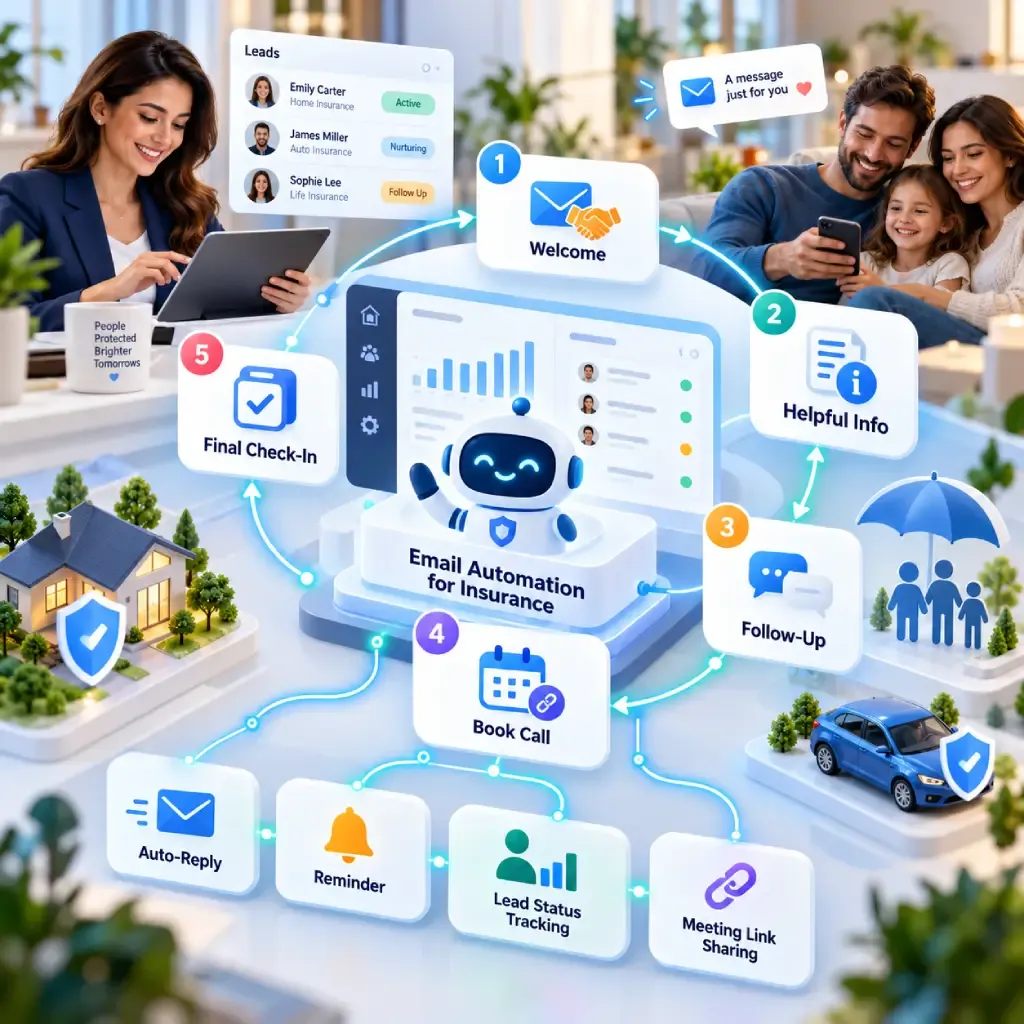
Following up with every prospect manually becomes difficult as your contact list grows.
Let’s say your agency receives 30 quote requests in a week.
Some prospects respond immediately. Others need more information. A few stop replying altogether.
Remembering when to follow up with every person can quickly become a full-time job.
This is where email automation helps.
Set Up a Simple Insurance Lead Follow-Up Sequence
Here’s an example of how an automated sequence could work:
Day 1: Welcome and acknowledgment
Thank the prospect for reaching out, confirm what they’ve requested, and explain what happens next.
Day 3: Helpful information
Send a short explanation of common coverage questions related to their insurance interests.
Day 6: Personal follow-up
Ask whether they need clarification or would like assistance comparing their options.
Day 10: Consultation invitation
Offer a convenient way to book a conversation with your agency.
Day 15: Final helpful check-in
Let them know you’re available if their insurance needs change.
This is an example schedule, not a rule. Adjust it based on the prospect’s preferences, buying stage, and responses.
Most importantly, your automation should stop or change when someone replies, opts out, books an appointment, or becomes a client.
How AI Can Help Insurance Agents Manage Email Conversations
Modern AI-powered marketing systems can do more than send emails at scheduled times.
Depending on their features and configuration, they can help you:
- Respond to common customer questions
- Send automatic follow-up messages
- Remind prospects about pending conversations
- Share calendar booking links when someone requests a meeting
- Organize prospect interactions for easier tracking
For example, a prospect might reply, “I’m interested, but I need to understand the deductible first.”
Instead of sending another generic sales email, an appropriately configured AI system could provide general educational information and alert the agent when personalized advice is needed.
For coverage recommendations, policy interpretations, or sensitive information, a qualified insurance professional should remain involved.
The idea isn’t to replace conversations with automation. It’s to make sure important conversations aren’t forgotten.
5. Create Email Campaigns Around Real Customer Needs

Not every email needs to promote an insurance policy.
In fact, if every message is a sales pitch, subscribers may stop paying attention.
The most effective insurance agent email marketing tips often come down to understanding what customers need help with.
Educational Email Campaigns
Insurance terms can be confusing.
An email explaining deductibles, exclusions, or coverage limits in plain English can be genuinely useful.
Possible topics include:
- What Does Home Insurance Actually Cover?
- Term Life Insurance vs. Permanent Life Insurance
- Common Mistakes When Choosing Auto Insurance
- Insurance Questions to Ask Before Starting a Business
These emails help establish your agency as a useful source of information.
Renewal Reminder Campaigns
Renewals are a natural opportunity to reconnect with existing clients.
For example, you might send a reminder 30 days before renewal, followed by a coverage review invitation.
Keep marketing messages separate from essential policy or servicing notifications where appropriate.
The goal is to help clients understand their options, not simply remind them to pay.
Referral and Relationship Campaigns
Satisfied customers may be willing to recommend your services.
A friendly check-in can encourage referrals without making customers feel like they’re part of a sales campaign.
You might write:
“Hope everything is going well with your coverage. If you know someone who has questions about insurance, I’m always happy to help.”
Simple messages like this can feel much more natural than a formal referral promotion.
Make sure any referral incentives comply with applicable insurance rules.
6. Track Results and Improve Your Email Marketing Strategy

Once your campaigns are running, you need to know what’s working.
Sending 1,000 emails doesn’t tell you much about whether your marketing is successful.
What matters is what happens afterward.
Important Email Marketing Metrics for Insurance Agents
Delivery and bounce rates
These help you understand whether your emails are reaching valid addresses.
Click-through rate
This shows how often recipients click links to learn more, request a quote, or schedule a consultation.
Reply rate
Replies are particularly valuable for insurance agents because they often lead directly to conversations.
Appointment booking rate
Track how many prospects schedule consultations after receiving your emails.
Lead-to-client conversion rate
Measure how many email-generated leads eventually become customers.
Unsubscribe rate
If many people unsubscribe after a campaign, you may be emailing too frequently or sending irrelevant content.
Don’t rely entirely on open rates. Email privacy features can affect how accurately opens are measured.
A Simple Example
Suppose your agency sends a campaign to 500 subscribers.
From that campaign:
- 40 people click your consultation link.
- 12 schedule appointments.
- 4 eventually purchase policies.
Those numbers are hypothetical, but they demonstrate why tracking appointments and actual sales matters more than celebrating email opens.
Review your results regularly. Test different subject lines, improve your calls to action, and identify the messages that generate meaningful conversations.
Over time, even small changes can help improve your results.
7. Follow Email Marketing Best Practices and Compliance Rules
Insurance involves personal information and important financial decisions. Your marketing should reflect that responsibility.
Before starting a campaign, review the rules that apply to your location, customers, and insurance products.
For example, commercial emails sent to recipients in the United States are generally subject to the CAN-SPAM Act.
According to the Federal Trade Commission, covered marketing emails must use accurate sender information and non-deceptive subject lines, provide a valid postal address, include appropriate advertising disclosures, and offer a clear way to opt out. Opt-out requests must be honored within 10 business days.
You should also consider applicable state insurance regulations, privacy requirements, and any rules imposed by insurers you represent.
For agencies serving customers outside the United States, additional requirements may apply.
Beyond legal compliance, follow a few practical habits:
- Use a recognizable sender name and professional email address.
- Explain why subscribers are receiving your emails.
- Keep unsubscribe options easy to find.
- Protect customer information and avoid including sensitive policy details unnecessarily.
- Review automated responses for accuracy.
- Avoid making promises about coverage, approval, premiums, or claims that aren’t supported.
Good email marketing should make people more comfortable trusting your agency, not less.
Frequently Asked Questions About Insurance Email Marketing
1. Does Email Marketing Really Work for Insurance Agents?
Yes, email marketing can help insurance agents generate leads, maintain customer relationships, and encourage repeat conversations.
Its effectiveness depends on the quality of your contact list, message relevance, follow-up process, and ability to convert interest into appointments and policy sales.
2. How Often Should Insurance Agents Send Marketing Emails?
For a general educational newsletter, starting with two to four emails per month may be reasonable.
Prospects actively requesting quotes may benefit from a shorter, more focused follow-up sequence. Always adjust the frequency based on engagement and subscriber preferences.
3. What Are the Best Email Marketing Strategies for Insurance Agents?
Some of the most useful strategies include segmenting contacts, sending educational content, following up on quotes, automating routine reminders, and tracking appointment bookings.
Personalized emails that address a specific insurance question generally provide a stronger reason to respond than generic promotional messages.
4. Can Insurance Agents Automate Email Follow-Ups?
Yes. Insurance agents can use marketing automation platforms to schedule messages, respond to common inquiries, send reminders, and support appointment scheduling.
However, automation should respect opt-outs, recognize when prospects have replied, and route complex insurance questions to a qualified professional.
5. How Can Insurance Agents Generate More Leads Through Email?
Start by attracting interested subscribers through quote forms, useful insurance guides, webinars, and existing customer relationships.
Then send relevant information and offer a clear next step, such as requesting a quote or booking a consultation. Track which campaigns produce actual appointments and customers.
Conclusion: Turn More Insurance Leads Into Real Conversations
Email marketing doesn’t have to be complicated to be useful.
You don’t need to send hundreds of promotional messages every week or create elaborate campaigns that take hours to manage.
Start with a clean email list. Understand what your prospects need. Write helpful messages. Follow up consistently. And pay attention to which conversations turn into appointments.
The most important insurance agent email marketing tips aren’t about clever subject lines or aggressive sales tactics. They’re about being helpful, staying organized, and showing up when people need guidance.
As your agency grows, handling every reply and reminder manually may become harder. That’s when automation can help you maintain consistent communication without adding more administrative work.
At Think To Share, we help businesses build custom software and AI-powered automation solutions to simplify customer communication, follow-ups, and lead management.
Want to spend less time chasing leads and more time helping clients?
Explore how Think To Share can help you build a smarter, more organized email marketing workflow for your insurance business.
